Sensex jumps 1,718 points to 81,028 as Indian shares shrug off global AI rout
US chip stocks had their worst day since 2020 and Seoul halted trading, but Indian banks led a seventh straight rise; the Nifty closed back above 25,000.
Indian shares closed sharply higher on Friday, the day of Dhanteras, even as a sell-off in artificial intelligence and chip stocks that began on Wall Street spread across Asia and forced a trading halt in Seoul. The BSE Sensex rose 1,718.01 points, or 2.17%, to 81,028.02, and the Nifty 50 gained 493.75 points, or 2.01%, to 25,030.35, back above 25,000, according to closing figures reported after the session. It was the seventh straight day of gains.
Banks and financial stocks led the rise, helped by heavy buying from foreign investors and lower oil prices, analysts said. The rupee strengthened to about 93.91 to the dollar, its strongest close since 22 April, according to one report.
India: from a flat open to a broad rally
The Sensex opened just 103.65 points higher at 79,413.66 and dipped to 79,016.05 in the morning before climbing through the afternoon. It was up about 1,230 points at 2:36 pm and 1,483 points in the closing auction, reports said. Mahindra and Mahindra, which rose about 4% after its quarterly results, ICICI Bank, Titan, HDFC Bank and Axis Bank were among the biggest gainers, while Power Grid, Tata Motors Passenger Vehicles, Eicher Motors, Grasim and Shriram Finance fell. The gains were concentrated in large companies: the Nifty Smallcap 100 fell 0.82% and the Midcap 100 was flat.
Foreign investors bought a net Rs 14,974.68 crore of Indian shares on Thursday, their largest one-day purchase in nearly six years according to one report, while domestic institutions sold Rs 10,444.54 crore. Friday's provisional figures were not yet available. "Markets extended their winning streak for the seventh consecutive session," said Ajit Mishra of Religare Broking, pointing to sustained foreign buying.
The global sell-off
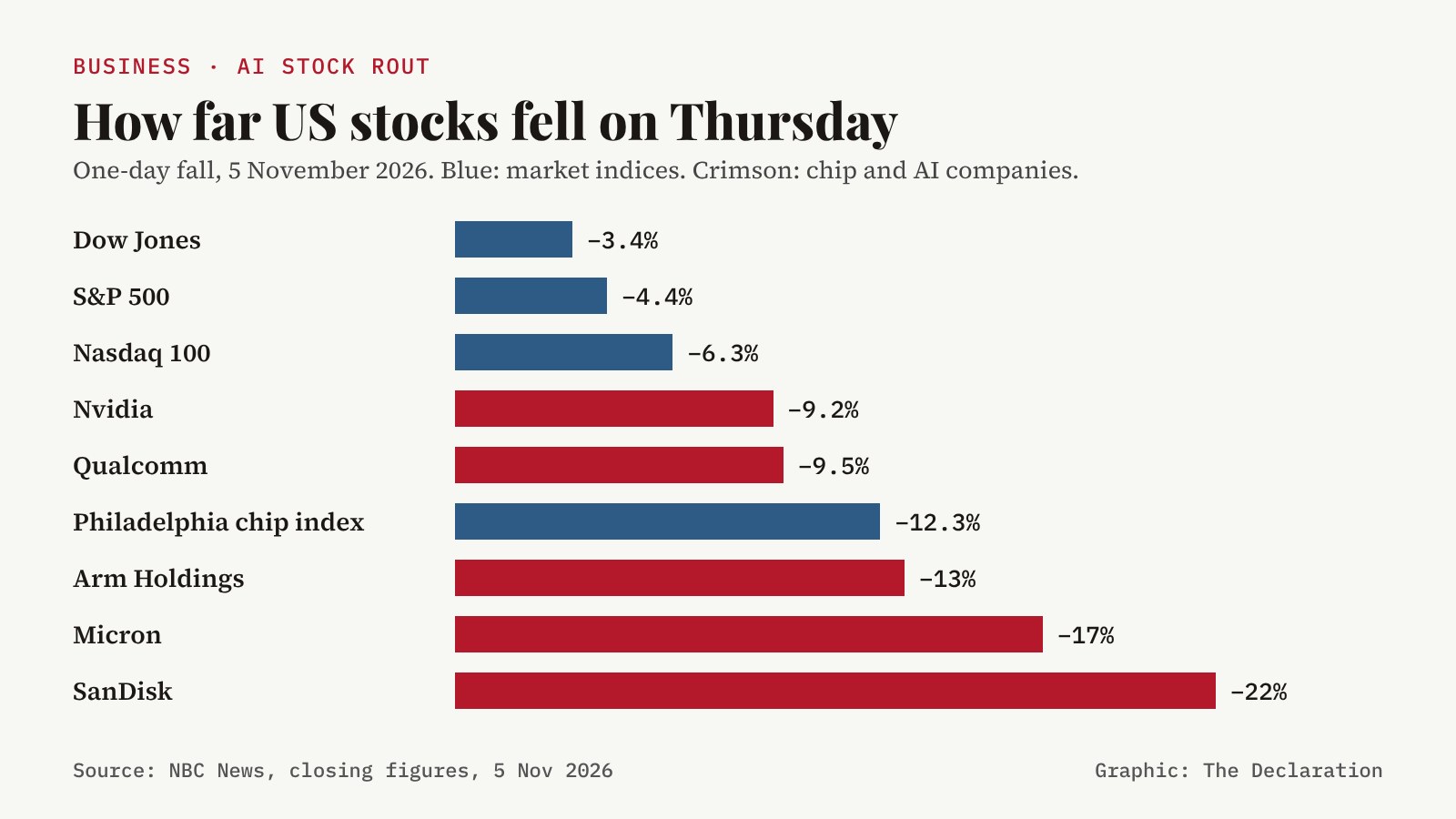
In New York the S&P 500 fell 4.4% and the tech-heavy Nasdaq 100 6.3% on Thursday, together wiping out about $2.8 trillion of market value, reports said, their worst day since April 2025. Investors were reacting to the scale of the Democrats' victory in Tuesday's midterm elections, in which many winning candidates promised to slow or halt the construction of the giant data centres that power AI, and to growing doubts about whether AI spending will pay off.
What happened
The Dow Jones Industrial Average fell 1,833 points, or 3.4%, and the Nasdaq Composite dropped more than 5.5%, taking it more than 10% below its recent peak, the level traders call a correction. The Philadelphia semiconductor index lost 12.3%, its worst day since March 2020, according to reports. Nvidia fell 9.2%, its biggest one-day drop since April 2025. Memory and storage makers were hit hardest: SanDisk fell 22%, and Micron, Western Digital and AMD about 17% each. Arm Holdings fell 13% and Qualcomm 9.5% after results on Wednesday that investors saw as mixed.
The selling moved to Asia as markets opened. South Korea's Kospi fell more than 8% about three minutes after the open on Friday, triggering a circuit breaker that halted trading for 20 minutes, reports said. The index fell below 5,000 for the first time in about ten months. By 10:30 am Seoul time SK Hynix was down 10.3% and Samsung Electronics 8%. Japan's Nikkei 225 fell as much as 5.7%, according to one report. On Thursday the Kospi had already lost 5.3%, another report said.
Why India held up
India has few listed companies that make chips or build AI data centres, which kept it out of the worst of the sell-off. One report carried analysts' view that worries about AI regulation could encourage a "reverse AI" trade that helps markets such as India. In the morning the Nifty IT index of software exporters rose 1.9% even as Asian technology stocks fell, according to National Stock Exchange index data.
Oil is the other channel. Brent crude rose about 4% on Thursday to settle at $98.29 a barrel as attacks on tankers near the Strait of Hormuz continued, reports said, and was quoted near $97 in the afternoon on Friday, after trading above $100 at midday, according to reports. It is still down sharply over the week.
Background: the data-centre backlash
Democrats flipped five governorships on Tuesday, in Texas, Georgia, Ohio, Iowa and Nevada, states that together hold 37% of planned US data-centre capacity, according to one analysis. In Texas, which alone accounts for 22.8%, Governor-elect Gina Hinojosa pledged in October to halt all new data-centre approvals until the legislature passes protections, one report said. The incoming governors of Georgia and Ohio, Keisha Lance Bottoms and Amy Acton, have pledged pauses on large new data centres. Voters approved nearly every local data-centre moratorium on the ballot.
Senator Bernie Sanders wrote on X: "National data center moratorium now," according to reports. Nomura analysts said a federal moratorium "looks unlikely", though state-level pauses remain possible, one report said.
What they are saying
"I don't think this is an AI bubble bursting," Ed Yardeni of Yardeni Research said in an interview, calling it instead "an AI bubble losing some air very, very rapidly". Nomura's Charlie McElligott said the selling did not reflect a fundamental deterioration in company prospects, according to one report.
President Donald Trump blamed his opponents. "The Stock Market suffered one of the Worst Days in History based on the results of the Election," he wrote on Truth Social, reports said.
Why it matters for India
Friday's trading suggested India is, for now, being treated as a shelter from the AI sell-off rather than a casualty of it. Analysts quoted in one report warned that this is relative resilience, not immunity: a broad global retreat from risk would still reach Indian shares through foreign selling, and a renewed rise in oil prices would weigh on the rupee and on inflation. Hariselvan Radhakrishnan, chief executive of HST Wealth, told reporters that pressure was likely to be concentrated in IT and other globally sensitive stocks.
What happens next
Traders cut their bets on a US interest-rate rise at the Federal Reserve's 8-9 December meeting, with the odds now about 60%, reports said. Investors will watch whether US markets steady on Friday and whether the incoming governors turn campaign pledges into orders once they take office.
Sources
- Original documentNational Stock Exchange: index data (Nifty 50, Nifty IT, Nifty Midcap 100, India VIX), 6 Nov 2026, 09:21 IST
- Tribune India (ANI): Dhanteras bonanza on D-Street, Sensex jumps 1,718 points, Nifty tops 25,000
- Free Press Journal: Sensex rockets 1,718 points as Nifty reclaims 25,000
- Business Recorder (Reuters): Indian rupee strengthens past 94 as oil slides, foreign inflows return
- DSIJ: Sensex surges 1,230 points, Nifty nears 24,900 as banks lead seven-day rally
- NBC News: Stocks plunge as election outcome and AI worries crush tech shares
- The Korea Times: AI investment fears spark panic selling in Samsung, SK hynix
- Business Today: Why stock markets are falling; behind AI rout and likely impact on India
- Business Standard: Stock Market LIVE, 6 November
- Yahoo Finance: Stock market today, Dow plunges 1,800 points, Nasdaq enters correction in AI trade meltdown
- CNBC: Top Democrats call to rein in AI buildout after midterms sweep
- The National: Democrats' midterm gains put US data centre boom under pressure
- WHIO (AP): A brutal sell-off for AI stocks sends Wall Street reeling
- HDFC Sky: GIFT Nifty signals mildly positive open for Sensex, Nifty on Friday
This story was researched and drafted with AI assistance and reviewed by an editor before publication. Spotted an error? Tell us. Corrections log.