Days before China's rare-earth pause ends, US tells Beijing to deliver 'immediately'
Beijing has not published a notice extending its suspension of the October 2025 export controls beyond 10 November. India, outside the US-China deal, would be exposed if they return.
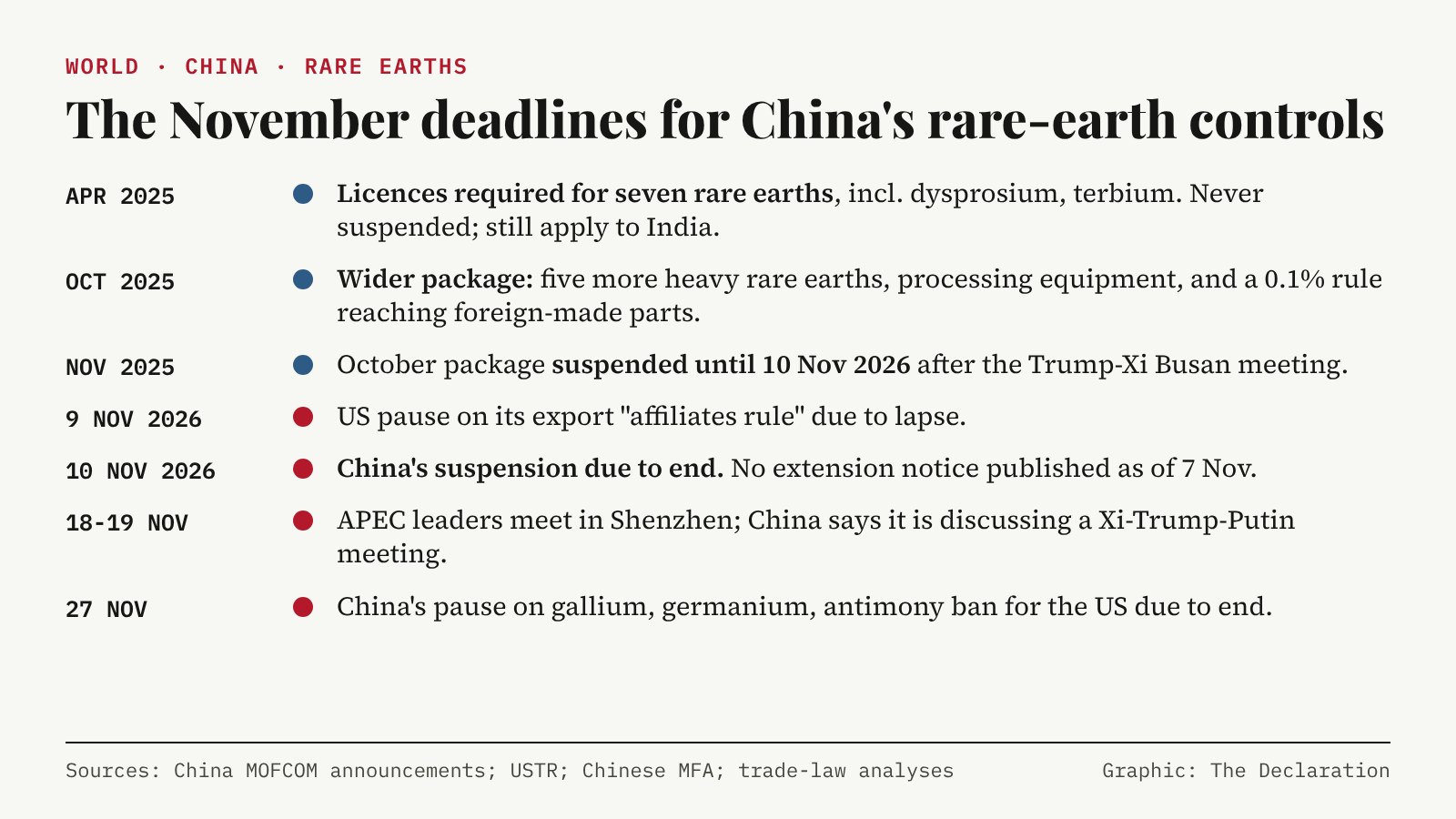
The United States has told China to carry out its trade commitments "fully and immediately", four days before the legal suspension of Beijing's sweeping October 2025 rare-earth export controls is due to run out on 10 November. China has not yet published a notice extending that suspension, and India, which is not part of the US-China arrangement, would be exposed if the controls come back.
The warning came in a video call on Friday, US time, between US Trade Representative Jamieson Greer, Treasury Secretary Scott Bessent and Chinese Vice Premier He Lifeng, Beijing's lead official on economic relations with Washington. Separately, China's foreign ministry has confirmed for the first time that it is in contact with "relevant parties" about a meeting between Chinese President Xi Jinping, US President Donald Trump and Russian President Vladimir Putin, which could take place at the Asia-Pacific Economic Cooperation (APEC) summit in Shenzhen on 18-19 November.
What happened
According to the readout published by the US Trade Representative's office, Mr Greer stressed "the critical importance of China taking concrete actions to fully implement its past commitments", naming purchases of American farm goods, rare earths and other critical minerals. The office said the administration would "monitor compliance" in pursuit of balanced trade.
The Treasury's readout, as quoted in reports, said Mr Bessent stressed China "fully and immediately implementing its commitments" under the deal reached when Mr Trump and Mr Xi met in Busan, South Korea, in October 2025. It said he "raised concerns about recent Chinese actions" and that "continued progress depends on concrete results". The readouts did not say which Chinese actions were meant.
China had not published its own account of the call by early Saturday, India time. At the Chinese foreign ministry's regular briefing on Friday, spokesperson Guo Jiakun referred a question on US farm purchases to the "competent authorities". Reports said China's commerce ministry had earlier in the week signalled that Beijing was open to buying more US farm products, provided that tariff cuts both sides had discussed were carried out.
On the proposed three-way summit, foreign ministry spokesperson Mao Ning, asked at Wednesday's briefing about talks among the three presidents during APEC, said: "China is in communication with relevant parties regarding a meeting between the three heads of state." Nothing has been announced by Washington or Moscow, and no format or date has been agreed.
Background: the rules that could return
In October 2025, China's Ministry of Commerce issued a package of export controls that went much further than earlier rules. It added five heavy rare earths (holmium, erbium, thulium, europium and ytterbium) to the list of controlled items, along with rare-earth processing equipment, some lithium-battery and graphite anode materials, and a new extraterritorial rule. That rule would require a Chinese licence for magnets and parts made outside China if they contain even 0.1% of rare earths of Chinese origin by value.
After the Busan meeting, Beijing suspended that package until 10 November 2026. In September 2026 the commerce ministry said the wider arrangement with the United States would run until 10 January 2027. That statement did not mention rare earths, and several trade-law analyses published in October and early November said no new numbered notice had been issued to carry the rare-earth suspension past 10 November. US officials, including Mr Bessent, have said the extension covers the controls. Until China publishes a notice, the legal position after 10 November is unclear.
Two other sets of rules are not affected. Licensing requirements that China imposed in April 2025 on seven medium and heavy rare earths, including dysprosium and terbium, which are used in high-performance magnets, were never suspended and still apply to buyers everywhere. And China's pause on a ban on exporting gallium, germanium and antimony to the United States runs until 27 November.
The United States has its own deadline. Its suspension of the Commerce Department's so-called affiliates rule, which extends export restrictions to companies at least 50% owned by listed firms and was paused as part of the Busan truce, ends on 9 November, and no notice extending it had appeared by Friday, according to analyses of the deadline.
What it means for India
India relies heavily on China for rare-earth magnets, which go into electric-vehicle motors, wind turbines, electronics and defence equipment. Indian carmakers and component makers spent months of 2025 waiting for Chinese licences under the April 2025 rules, and some warned of production cuts while shipments were held up.
If the October 2025 package returns on 11 November, the risks for India would rise in two ways. Five more elements would need Chinese export licences. And the 0.1% rule could reach Indian-made components containing Chinese-origin rare earths that are exported to third countries, giving Beijing a say over parts of India's export trade.
Even if Washington and Beijing extend their truce, any relief negotiated for the United States does not automatically apply to Indian buyers, who would still face the April 2025 licensing regime. India has started a scheme to build domestic magnet-making capacity, but new plants will take years to come on stream.
A meeting of the Chinese, US and Russian leaders without India would also matter diplomatically. India is a member of the Quad with the United States, and of the BRICS group and the Shanghai Cooperation Organisation with China and Russia, and it remains a major buyer of Russian oil.
What they are saying
Analysts quoted in reports differed on the three-way summit. Sun Yun of the Stimson Center said: "I think it will happen. The question is the format and the content." Danny Russel of the Asia Society Policy Institute said "Putin has the most to gain from a leaders' trilateral." Craig Singleton of the Foundation for Defense of Democracies said such meetings had "diminishing diplomatic returns".
Beijing has consistently said its export controls are lawful measures to protect national security and meet non-proliferation obligations, and are not aimed at any particular country.
What happens next
- 9 November: the US suspension of the affiliates rule is due to lapse; China releases October trade figures; Mr He co-chairs a China-Canada economic dialogue in Canada.
- 10 November: China's suspension of its October 2025 rare-earth controls is due to end unless the commerce ministry extends it.
- 18-19 November: APEC leaders meet in Shenzhen, where Mr Trump is expected to meet Mr Xi.
- 27 November: China's pause on its gallium, germanium and antimony ban for the US is due to end.
Sources
- Original documentUSTR: Readout of Ambassador Greer's call with China's Vice Premier He Lifeng, 6 Nov 2026
- Original documentChinese Ministry of Foreign Affairs: spokesperson Mao Ning's regular press conference, 4 Nov 2026
- Original documentChinese Ministry of Foreign Affairs: spokesperson Guo Jiakun's regular press conference, 6 Nov 2026
- Original documentUS Treasury: readout of Secretary Bessent's call with Vice Premier He Lifeng
- AP (via WSLS): China confirms discussions are underway on a historic Xi-Trump-Putin meeting
- The Epoch Times: US tells China to immediately meet trade commitment ahead of Trump-Xi meeting
- Carra Globe: China rare earth export controls 2026
- Bytes Europe: rare-earth suspension deadline analysis
- RAWMATERIALS.net: China confirms extension of trade arrangements with US
This story was researched and drafted with AI assistance and reviewed by an editor before publication. Spotted an error? Tell us. Corrections log.