Centre clears 26 new roads along the China border in Arunachal, reports say
The third phase of the India-China Border Roads programme was approved in February, according to an unnamed official, after months of face-offs in the state. The government has not announced it.
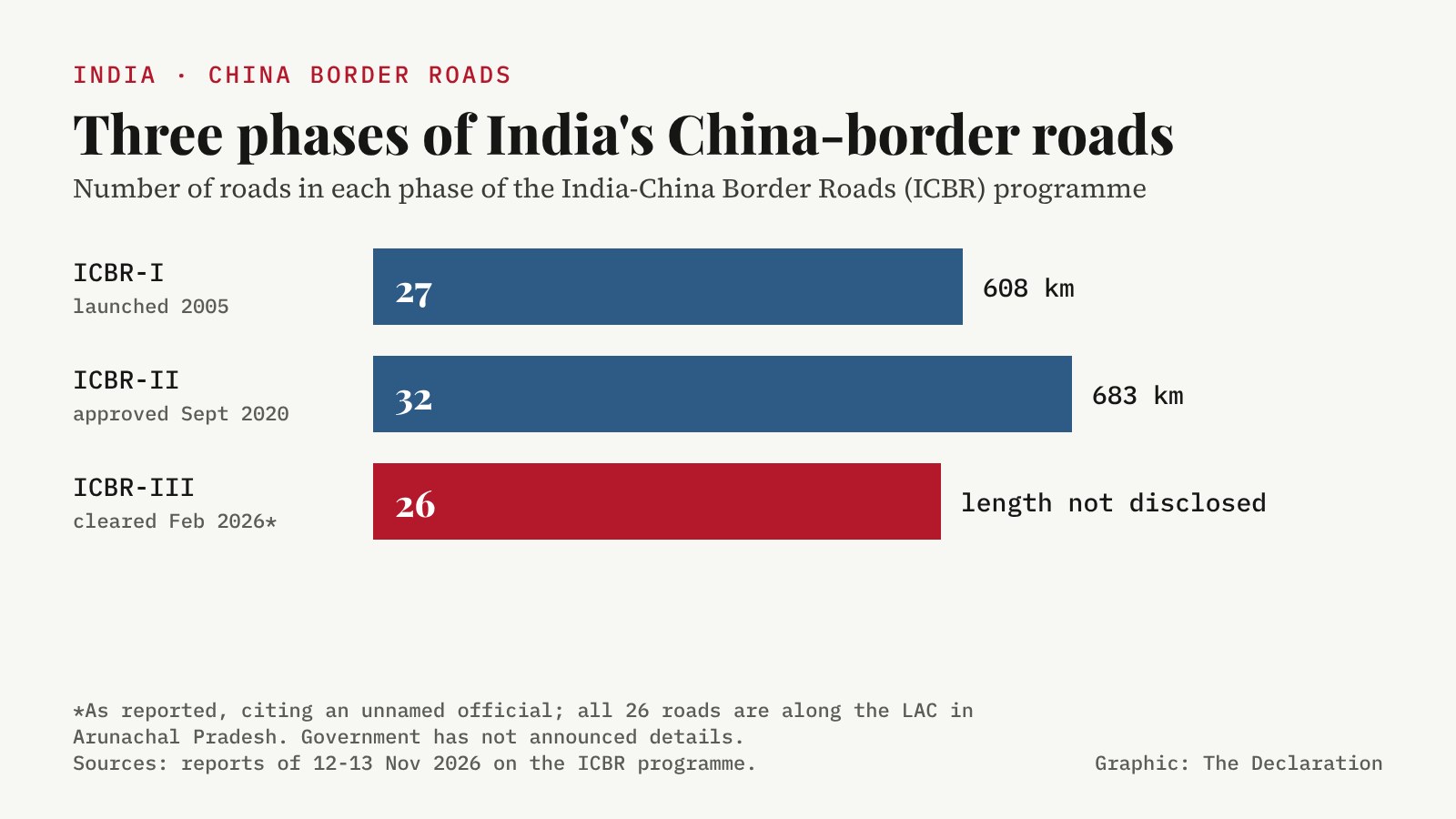
The Centre has approved a third phase of its programme of strategic roads along the border with China, with 26 new roads planned close to the Line of Actual Control (LAC) in Arunachal Pradesh, according to reports on Thursday citing an unnamed government official. The approval comes after months of face-offs between Indian and Chinese troops in the state.
The Cabinet Committee on Security cleared the third phase of the India-China Border Roads (ICBR) project in February, the reports said. The government has not formally announced it or published its cost, length or timelines. Separately, the Indo-Tibetan Border Police (ITBP) has since September authorised 15 pedestrian suspension bridges and 18 log bridges in the Upper Subansiri and Kurung Kumey districts, which lie along the LAC, according to the reports.
How big the programme is
The ICBR programme began in 2005, when the first phase listed 27 priority roads totalling 608 km along the China border. A second phase of 32 roads covering 683 km was approved on 21 September 2020, three months after the clash in the Galwan valley in Ladakh in which 20 Indian soldiers were killed. The new phase is only the second major China-border road package approved since Galwan, according to the reports. Its total length has not been made public.
The roads are meant to let troops and supplies reach forward areas in hours rather than days, and to give border villages, many of them reachable only on foot, a link to the rest of the state.
Why now
Indian and Chinese troops have had face-offs in Arunachal Pradesh since late July. A former director general of the ITBP said on 22 October that these were taking place "at several locations" in the state, according to reports. The two governments have held three rounds of talks since July: the 36th meeting of their Working Mechanism for Consultation and Coordination on border affairs on 6 August, the 25th round of Special Representatives talks in Beijing on 26 August, and the first meetings of corps commanders for the eastern sector, held in Arunachal Pradesh on 6 September.
China claims almost all of Arunachal Pradesh, which it calls "Zangnan", and has in recent years issued its own names for places in the state, a move India has rejected each time, saying the state is an integral part of India. China has also built roads, rail links and new "xiaokang" border villages on its side of the LAC over the past decade.
No response from Beijing to the reports had been published by Friday afternoon. It has in the past objected to Indian leaders' visits to and projects in Arunachal Pradesh.
The risks for India
The roads address a long-standing gap. Without them, Indian forces depend on long, slow supply lines in some of the most difficult terrain on the border, while Chinese forces can move quickly on roads on the far side. But building close to a disputed line also carries risk: China has objected to Indian infrastructure in border areas before, and the work is going ahead while face-offs in the state continue and talks on easing them are still under way.
The work also comes in the same state as the planned Siang Upper Multipurpose Project, a large dam that India has presented as a way to buffer the Brahmaputra's flow against China's giant hydropower project on the Yarlung Tsangpo upstream, and which faces opposition from local communities. Downstream, the Brahmaputra feeds Assam and Bangladesh, and China's sharing of river-flow data with India has been a recurring issue between the two governments.
What happens next
The government has not said when construction on the new roads will begin, which agency will build them, or what they will cost. Parliament has not sat since the Monsoon Session was adjourned on 13 August, and no date has been set for the next sitting, so official details may come only when MPs can put questions to the government.
Sources
This story was researched and drafted with AI assistance and reviewed by an editor before publication. Spotted an error? Tell us. Corrections log.