Agniveers get a second two-year term and a path to regular service, Cabinet decides
The 75% who were to leave after four years can now serve two more, with higher pay, and then be enrolled as regular soldiers if they qualify. The first batch of over 18,300 was due out by December.
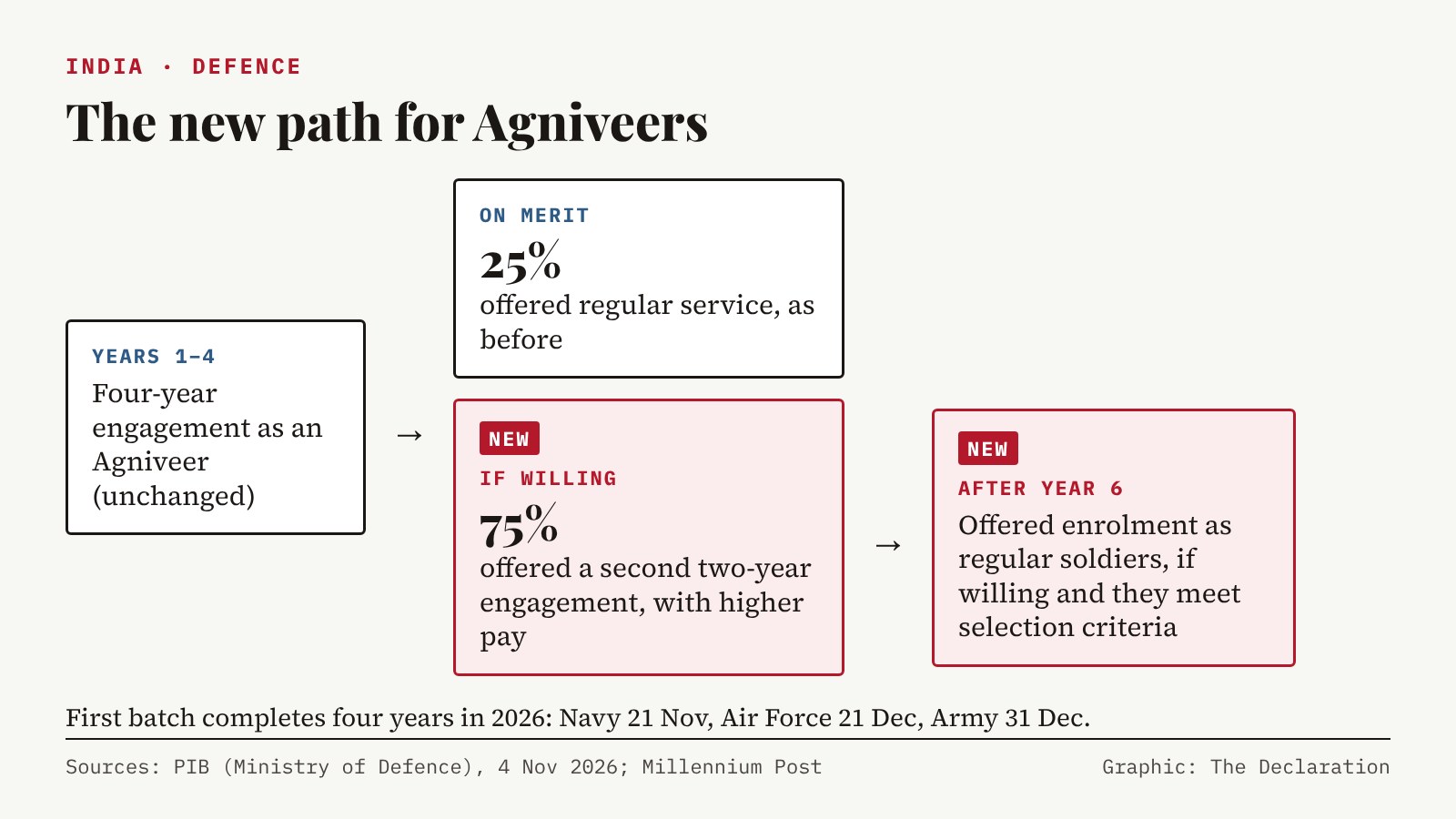
The Union Cabinet on Wednesday approved a second, two-year term of service for Agniveers, the soldiers recruited on four-year contracts under the Agnipath scheme, and said all of them can then be enrolled as regular soldiers if they are willing and meet the selection criteria. The decision comes weeks before the first batch of more than 18,300 was due to leave the forces.
Under the original 2022 scheme, up to 25% of each batch was to be kept on as regular soldiers and the other 75% sent home after four years with a lump sum and no pension. That 25% will still be chosen on merit. The other 75% will now be offered two more years, with "higher remuneration, enhanced Seva Nidhi package and seniority benefits", the Ministry of Defence said in its release. The Congress said the change vindicated its long opposition to the scheme.
What the Cabinet decided
The defence ministry's release, issued through the Press Information Bureau at 4.14 pm IST, said an "objective assessment" of organisational needs and operational efficiency had brought out the "outstanding performance" of Agniveers in skills, motivation, physical fitness and technology. On the recommendation of the defence forces, the Cabinet approved "another engagement period of 2 years" for the remaining 75%.
"After completion of this two-year engagement period, all Agniveers will be offered enrollment as regular soldiers subject to their willingness and their meeting selection criteria." (Ministry of Defence release)
The release said the Agnipath scheme "shall continue" and that the Cabinet had "created a pathway for absorption of all Agniveers into Defence Forces". It did not give pay figures, the size of the new Seva Nidhi package, or the selection criteria for regular enrolment.
Chief of Defence Staff General N.S. Raja Subramani announced the decision in New Delhi. He said the forces had been studying an extension for three to four months, that the scheme "was not set in stone", and that the change was "a win-win situation for both" the forces and the soldiers, The Week reported. He said the four-year first term stays as it is.
Two points remain unclear from what has been published so far. The release does not say whether a soldier who completes the second term is assured of a regular post or only eligible to compete for one; it says only that enrolment is "subject to" selection criteria. And it does not say whether the second term counts towards a pension.
Who it affects first
The first recruitment cycle took in about 24,400 people: roughly 19,000 in the Army, 2,850 in the Air Force and 2,550 in the Navy, according to the Millennium Post. More than 18,300 of them were due to finish their four years and leave by 31 December. The Navy's first batch completes its term on 21 November, the Air Force's on 21 December and the Army's on 31 December, the paper reported.
Reports differ on how they describe the numbers. The Week put the outgoing cohort at about 18,000; the Millennium Post said more than 18,300. The government's release gives percentages, not headcounts.
Background
The government announced the Agnipath scheme on 14 June 2022, replacing the old system of long-service recruitment for soldiers, sailors and airmen below officer rank. Recruits aged 17.5 to 21 would serve four years, including training. Those not retained would leave with a Seva Nidhi lump sum of about Rs 11.71 lakh, part of it from their own contributions, but no pension or gratuity.
The announcement set off violent protests, mainly by young people who had been preparing for regular army recruitment. Trains were set on fire in Bihar, and protests spread to Uttar Pradesh, Haryana, Telangana and other states. The government raised the upper age limit to 23 for the first year only. National Security Adviser Ajit Doval said at the time that the scheme would not be rolled back.
Since then the Centre and several states have offered ex-Agniveers reserved places in other uniformed jobs. The Central Industrial Security Force, the Border Security Force and the Railway Protection Force announced a 10% reservation and age relaxation in July 2024, and states including Haryana and Odisha announced quotas in their police forces.
Opposition parties, including the Congress, the CPI(M) and the CPI, demanded in 2022 that the scheme be rolled back or put on hold, and the Punjab Assembly passed a resolution urging a rollback. Retired senior officers also questioned whether a four-year term was long enough to build a capable soldier.
What they are saying
Defence Minister Rajnath Singh thanked Prime Minister Narendra Modi on social media and called the second term "a significant step in the continuing structural reforms of the armed forces", the Millennium Post reported. He said it would help build a younger, fitter and technologically equipped force for the "changing nature of warfare", according to the public broadcaster News On AIR.
Congress spokesperson Pawan Khera thanked the prime minister for what he called a second tour of duty, while noting that the 25% permanent absorption rule was unchanged, NewsDrum reported. He said Mr Gandhi had warned that the scheme was unsustainable, and called it "Yet another 'I told you so' moment for Rahul Ji". The report said the Congress linked the timing to coming Assembly elections in states that send many recruits to the forces. The government has not responded to that charge.
What happens next
- The government is expected to issue the detailed terms of the second engagement, including pay, the new Seva Nidhi package and the selection process for regular enrolment.
- 21 November: the Navy's first batch completes four years.
- 21 December: the Air Force's first batch completes four years.
- 31 December: the Army's first batch completes four years.
The change applies across the country, including to Agniveers from Bengal in the first batch who were due home this winter: they can now choose to stay on for two more years.
Sources
- Original documentPIB: Ministry of Defence release, 'Cabinet creates a pathway for all Agniveers to be absorbed in Defence Forces' (4 Nov 2026)
- Original documentPIB (2022): 'AGNIPATH' scheme for recruitment of youth in the Armed Forces
- News On AIR: Agniveers get two-year extension as Cabinet approves extension of service period
- News On AIR: Extension of Agniveers, a way to prepare country for changing nature of warfare: Rajnath Singh
- The Week: Govt to extend tenure of Agniveers by two years. How will this be implemented?
- Millennium Post: Cabinet approves two-year extension for Agniveers, opens path to permanent service
- NewsDrum: Agniveers due to retire in 2026 get extension till 2028; Congress calls it pre-poll reversal
- Wikipedia: Agnipath Scheme (background on 2022 protests and later reservations)
This story was researched and drafted with AI assistance and reviewed by an editor before publication. Spotted an error? Tell us. Corrections log.