China's corridor to the Bay of Bengal advances through Myanmar's rebel-held borderlands
Armed groups that hold the Chinese border are opening trade gates and planning a 200 sq km zone with Yunnan, while the corridor's end point, Kyaukpyu, sits near India's Kaladan project.
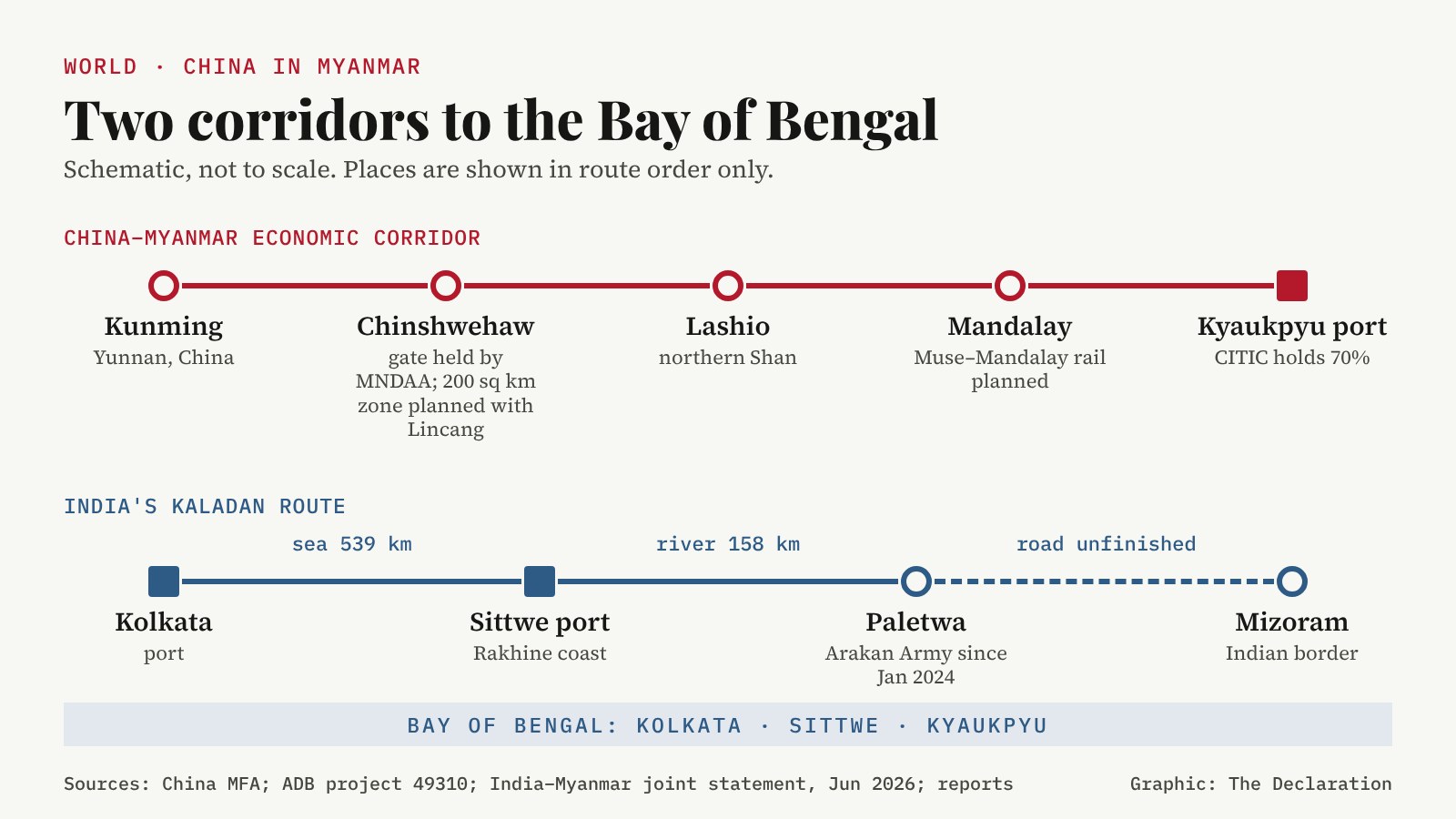
Armed groups that control much of Myanmar's border with China are building the trade gates, bridges and roads of Beijing's planned economic corridor to the Indian Ocean, even as China publicly backs the military-led government in Naypyitaw. The Myanmar National Democratic Alliance Army (MNDAA) opened a new border-trade gate at Chinshwehaw in early October, and the Ta'ang National Liberation Army (TNLA) is upgrading the crossing in Namkham township further east, according to an analysis published this week and reports from the region.
The work matters for India because the corridor ends at Kyaukpyu, a Chinese-run deep-sea port planned on the Bay of Bengal coast of Rakhine state, the same coast where India built Sittwe port for its own Kaladan transit project to the north-east. China's foreign ministry describes the China-Myanmar Economic Corridor as "a flagship project of the Belt and Road cooperation".
What happened
Chinshwehaw lies in the Kokang region of northern Shan state, across the border from Lincang in China's Yunnan province. The analysis, carried in a regional security newsletter on Friday, describes a planned Chinshwehaw-Lincang border economic cooperation zone of 200 square kilometres linking Laukkai, the Kokang capital, with Lincang, with export and import zones, factories in Kunlong, a bridge over the Salween river and upgraded highways. Planned rail and road links would run from Kunming through Chinshwehaw and Kunlong to Lashio, joining the corridor that continues to Kyaukpyu.
The zone is not new on paper. On 16 May 2017 China's and Myanmar's commerce ministries signed a memorandum that included "a plan to jointly develop" a 200 sq km border economic zone at Chinshwehaw, according to a project document of the Asian Development Bank (ADB). The ADB approved a $250 million loan in December 2018 for the Lincang side of the zone, describing the area as lying "along a planned strategic trade route for China to access Myanmar's seaports on the Indian Ocean". The loan's closing date was extended to 31 August 2026, according to the bank's project page.
What has changed is who holds the Myanmar side. The MNDAA seized most of Kokang in the 2023 offensive known as Operation 1027 and, according to the Myanmar research group ISP-Myanmar, now "controls most of the key Myanmar-China trade routes, border gates, and economic hubs" in northern Shan. In March 2026 it took Kutkai from the TNLA, a former ally, and reopened the Lashio-Muse road, the main China-Myanmar trade route, after a month-long closure, reports said. The TNLA has presented plans to residents for a two-lane, 100-tonne bridge over the Shweli river at Namkham and a new border gate with customs facilities, to be built in 2026-27, according to one report. It has not announced the project officially.
The MNDAA has published its own Chinese-language economic policy, which plans border zones, bonded warehouses and cold-chain logistics under the corridor and the Belt and Road, and lists lead, zinc, copper, gold, silver and antimony among minerals it intends to develop, according to earlier analysis of the document.
Background
China brokered a ceasefire between Myanmar's military and the MNDAA in Kunming in January 2025. Its foreign ministry said then that fighting stopped at midnight Beijing time on 18 January and that "China firmly supports Myanmar in safeguarding independence, sovereignty, national unity and territorial integrity". Under China-brokered deals the MNDAA handed the city of Lashio back to the military in April 2025, and the TNLA withdrew from several towns later that year, according to the International Crisis Group.
Myanmar held a three-phase election from December 2025 to January 2026 from which the National League for Democracy was excluded. Parliament elected the former junta leader, Min Aung Hlaing, president on 3 April 2026. China congratulated him the same day and said it was ready to "promote high-quality BRI cooperation".
During his state visit to Beijing in June, President Xi Jinping told him that China would "steadily advance the construction of major projects on the basis of ensuring safety and security", and that China "is committed to the principle of noninterference in internal affairs", according to China's foreign ministry. Their joint statement of 17 June named the Kyaukpyu deep-sea port and the Muse-Mandalay railway as corridor projects, and said: "The Myanmar side reiterated that it will protect the security of Chinese projects in Myanmar." On Tuesday this week, Foreign Minister Wang Yi again asked a Myanmar minister in Beijing to protect Chinese personnel and projects.
China's state-owned CITIC group holds 70% of the Kyaukpyu port venture and a Myanmar government body 30%, under a 2018 agreement that also cut the first phase to about $1.3 billion amid concerns over debt. China already runs oil and gas pipelines from the Rakhine coast to Yunnan, which let some of its energy imports bypass the Strait of Malacca.
Why it matters for India
China is dealing at once with the government in Naypyitaw, which it recognises, and with the armed groups that hold the border, which it can pressure through trade and border closures. That leverage over both sides is what lets the corridor advance through a civil war. For India the risks are threefold.
First, the Bay of Bengal. A working port at Kyaukpyu, connected by road, rail and pipeline to Yunnan, would give China a commercial outlet on the bay that India treats as its own strategic backyard, a few hundred kilometres along the coast from Sittwe and across the water from Kolkata and Haldia.
Second, India's own corridor is stalled. The Kaladan project was meant to link Kolkata to Mizoram by sea to Sittwe (539 km), by river to Paletwa (158 km) and by road to the Indian border. The road leg is unfinished, and Paletwa has been held by the Arakan Army, another armed group, since January 2024. Sittwe and Kyaukpyu remain in the military's hands. India's shipping minister set a 2027 target to make the route operational.
Third, the border itself. Northern Shan's armed groups are opening themselves to Chinese investment and mining, including antimony, which China treats as a critical mineral, at a time when India is trying to cut its dependence on Chinese supply chains.
India has kept its own channel to Naypyitaw. Min Aung Hlaing made his first foreign trip as president to India, from 30 May to 3 June, before going to Beijing. The two governments backed "completion of Kaladan Multi-Modal Transit Transport project" and Myanmar assured India that "its territory would not be permitted to be used against India's security interests", according to their joint statement.
What they are saying
China says its role is to promote peace. Its June joint statement records Myanmar's acknowledgement of "China's positive and constructive role ... particularly in facilitating peace talks in northern Myanmar", and Beijing says its projects follow "commercial viability, financial sustainability". The analysis published this week warned that the borderland model could split the frontier into semi-autonomous zones whose fate depends on Beijing's priorities. The Crisis Group wrote in June that "Beijing's backing for Naypyitaw should be understood as an effort to manage instability rather than resolve it".
What happens next
China and Myanmar are expected to keep pushing the Muse-Mandalay railway and Kyaukpyu port, the projects named in June. The war, however, is not over: one analyst wrote on 30 October that the conflict "remains stalemated" and that the military has recovered only about 9% of the territory it lost. India's test is whether the Kaladan road can be finished by 2027 through territory it does not control.
Key numbers
- 200 sq km: planned Chinshwehaw-Lincang border zone (2017 commerce ministries' memorandum)
- $250 million: ADB loan for the Lincang side, approved December 2018
- 70%: CITIC's stake in the Kyaukpyu port venture
- 539 km and 158 km: Kaladan's sea and river legs from Kolkata via Sittwe to Paletwa
Sources
- Original documentChina Ministry of Foreign Affairs: Xi Jinping holds talks with Myanmar President Min Aung Hlaing, 16 Jun 2026
- Original documentChina Ministry of Foreign Affairs: Joint statement of China and Myanmar, 17 Jun 2026
- Original documentChina Ministry of Foreign Affairs: spokesperson Mao Ning on Min Aung Hlaing's election, 3 Apr 2026
- Original documentChina Ministry of Foreign Affairs (via embassy): Mao Ning on Kunming ceasefire with MNDAA, 20 Jan 2025
- Original documentAsian Development Bank: Yunnan Lincang Border Economic Cooperation Zone Development Project, RRP PRC 49310 (PDF)
- Original documentAsian Development Bank: project 49310-002 page
- Original documentPM India: India-Myanmar joint statement during the official visit of the President of Myanmar, 1 Jun 2026
- The Irrawaddy: China's BRI plans take shape in Myanmar's rebel-held borderlands
- Indo-Pacific 5x5: November 6th 2026, Issue 456
- The Irrawaddy: Kokang's new power play, economic integration with China
- ISP-Myanmar: the MNDAA and northern Shan's conflict economy, 10 May 2026
- DVB: Vital Myanmar-China trade route under MNDAA control
- BNI: TNLA plans major border infrastructure upgrade to boost China trade
- International Crisis Group: Myanmar's new administration, military consolidation not transition
- Asialink (ISEAS Fulcrum): A new five-point consensus should give Myanmar's resistance a seat at the table
- Reuters: China to take 70 percent stake in strategic port in Myanmar
- Wikipedia: Kaladan Multi-Modal Transit Transport Project
This story was researched and drafted with AI assistance and reviewed by an editor before publication. Spotted an error? Tell us. Corrections log.