Myanmar lost the genocide case, but the Arakan Army holds the land the Rohingya fled
The World Court's first genocide finding against any state orders Myanmar to let the Rohingya return to territory its government no longer controls. What happens next will shape Bangladesh's camps, India's Kaladan corridor and the contest with China on the Bay of Bengal.
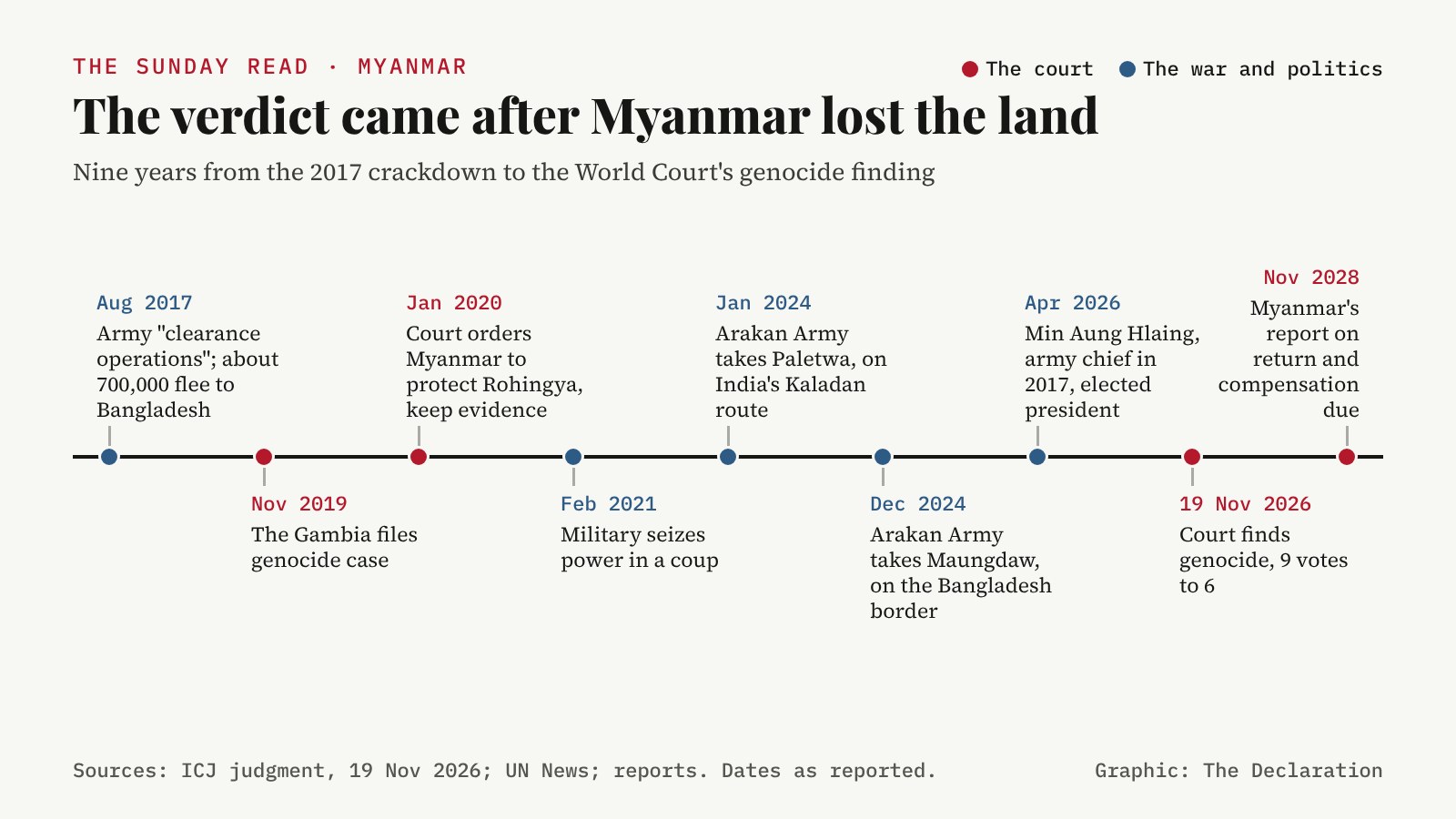
On Thursday, 19 November, the International Court of Justice found that Myanmar committed genocide against the Rohingya in northern Rakhine State in 2017. It is the first time the United Nations' highest court has found any state responsible for the crime. The court ordered Myanmar to prosecute those responsible, to compensate the victims and to allow the "safe, voluntary and dignified return" of the Rohingya. The ruling is final and cannot be appealed.
The government that must carry out these orders no longer controls the land in question. The Arakan Army, an ethnic Rakhine armed group fighting Myanmar's military, holds 14 of Rakhine's 17 townships and almost all of the border with Bangladesh, according to reports. That includes Maungdaw and Buthidaung, the townships from which most of the Rohingya fled. The army's commander in 2017, Min Aung Hlaing, is now Myanmar's president, and his government has called the ruling "unfair".
That gap between where the law falls and where power lies is what the headlines have mostly missed. It decides whether about 1.2 million refugees in Bangladesh ever go home. It also bears on whether India's Kaladan corridor through Rakhine ever opens, and on how China, India and Bangladesh compete over Myanmar's Bay of Bengal coast. For India and Bengal, the next moves after the verdict matter more than the verdict itself.
What is happening
The court ruled in a case brought by The Gambia in 2019 under the 1948 Genocide Convention. It decided by nine votes to six that Myanmar "has committed genocide against the Rohingya group in northern Rakhine State". It held that soldiers and other state organs killed Rohingya, caused them serious bodily or mental harm and imposed measures intended to prevent births. It accepted an estimate of at least 10,000 people killed. That is about 1.2% of a targeted population of about 815,000, and the court said a lower share of deaths "does not, by itself, necessarily preclude" a finding of genocide. UN News, summarising the judgment, reported that nearly 400 villages were partly or wholly destroyed, about 40% of those in three northern townships.
The other findings drew different majorities. By 11 votes to 4, the court found that Myanmar had failed to punish genocide. By 14 to 1, it found that Myanmar had failed to pass the laws the convention requires. By 13 to 2, it ordered Myanmar to investigate everyone reasonably suspected of genocide-related acts in the 2017 operations and, if warranted, to prosecute them. It cleared Myanmar, by 14 to 1, of directly and publicly inciting genocide.
The remedies are the part of the judgment that reaches into the future. By ten votes to five, the court ordered "restitution" in five parts:
- allow and facilitate the safe, voluntary and dignified return of displaced Rohingya, in Myanmar or abroad, and reunite families
- return or replace lost property
- search for the disappeared and help rebury the dead
- provide physical and psychological rehabilitation
- "ensure the protection of the Rohingya from discrimination and persecution"
The court said the last measure includes protection from discrimination "in accessing citizenship and with respect to freedom of movement". The judgment says Myanmar's 1982 citizenship law, as applied, has left about one million Rohingya stateless. Myanmar must also compensate the group. Within two years, it must send the court a report on what restitution it has carried out and what compensation it proposes. The court will then fix the amount.
The reactions split along familiar lines. Myanmar's government said the decision was not unanimous and "not fair", according to reports. In a later statement, its foreign ministry said the evidence did not meet the standard of proof and described the 2017 operations as counter-terrorism, reports said. China's foreign ministry said it "noted" the judgment, raised "concerns regarding such issues as ultra vires jurisdiction and overreach in interpretation", and said the Rakhine issue should be handled "prudently through a holistic approach". Britain expelled Myanmar's defence attaché and called for a session of the UN Security Council. Bangladesh's foreign ministry said Myanmar "is now legally bound to comply fully". India's Ministry of External Affairs said on 20 November that India had "taken note of the verdict" and had always supported the "safe, speedy and sustainable return" of the Rohingya, according to reports of the briefing. The statement did not use the word genocide.
How we got here
The Rohingya, a Muslim minority in a Buddhist-majority country, were stripped of most routes to citizenship by the 1982 law and placed under successive identity regimes that restricted their movement, work and education. The judgment notes evidence that Myanmar stopped issuing birth certificates to Rohingya in the 1990s. In August 2017, after attacks on police posts by the Arakan Rohingya Salvation Army (ARSA), the military launched what it called "clearance operations" across northern Rakhine. About 700,000 people fled to Bangladesh, UN News reported.
The Gambia filed its case in November 2019 with the backing of the Organisation of Islamic Cooperation. In January 2020 the court ordered Myanmar to protect the Rohingya and preserve evidence. It has now found that Myanmar broke that order, citing a UN finding that the remains of Rohingya villages in Buthidaung were burned in May 2020 and a UN investigators' report that a border-guard base was built on the site of former villages in 2021. The military seized power in February 2021. After a three-phase election from December 2025 to January 2026, from which the National League for Democracy was excluded, parliament elected Min Aung Hlaing president on 3 April 2026.
Meanwhile the war changed the map. The Arakan Army took Paletwa, on India's Kaladan route, in January 2024 and Maungdaw, on the Bangladesh border, in December 2024, according to reports. Myanmar's military is now confined to Sittwe, the Kyaukphyu port area and Manaung island, according to reports. Fighting in Rakhine pushed a new wave of Rohingya across the border. The UN-led Joint Response Plan for 2026 counts more than 140,000 new arrivals in the camps since 2024 and plans for up to 35,000 more this year.
What the headlines miss
The obligations fall on a state that does not hold the ground. A judgment against Myanmar binds the government in Naypyitaw. Return to Maungdaw or Buthidaung, however, now runs through Arakan Army checkpoints. The Arakan Army is not a party to the case and has made no public comment on the verdict, according to reports. Rohingya leaders and analysts say it has no power to grant citizenship, which is the remedy the court ties most closely to non-repetition. In 2024, UN human rights officials reported killings, including beheadings, and enforced disappearances attributed to the Arakan Army. The group denies targeting civilians. A UN report in September 2025 found the military and the Arakan Army acting with "near complete impunity", although it said abuses by anti-military groups were not comparable in scale to the army's.
Bangladesh has already changed its approach. On 8 November, Bangladesh's state minister for foreign affairs, Shama Obaed Islam, said Dhaka was "talking to the Myanmar government" and also "establishing contact and holding discussions with the Arakan Army", according to reports. She called it "naive" to expect returns through traditional diplomacy alone. After the verdict, she asked governments to press both the military and the Arakan Army.
The money is running out faster than the law is moving. The 2026 Joint Response Plan asks for $710.5 million, 26% less than in 2025, to serve about 1.25 million refugees and 307,000 people in host communities. It was less than half funded by August, according to an analysis by the Observer Research Foundation. In April, the World Food Programme moved from flat rations to aid targeted by need. A two-year reporting deadline means little in camps that cannot plan beyond the next funding cycle.
The legal standard has shifted. The court kept its rule that genocidal intent must be "the only reasonable inference" from the evidence, but it explained the rule in a way that matters for future cases. Intent can exist alongside other aims, the judgment says, and the test is met when "the totality of the evidence can only be explained by the perpetrator's genocidal intent". Six judges dissented. They included Vice-President Julia Sebutinde and the Chinese judge, Xue Hanqin. In a joint opinion they accepted that grave crimes had been committed but found genocidal intent unproven, pointing to the limited geographic scope of the operations, according to reports. Lawyers will cite the majority's reasoning in other genocide cases before the court, including South Africa's case against Israel.
How this could change things
Three paths stand out. Which one Myanmar takes depends less on the judges than on Naypyitaw, the Arakan Army, Dhaka and Beijing.
Scenario one: a verdict on paper. If Myanmar refuses to comply and the Security Council does nothing, the ruling becomes a moral record without practical effect. This is likely because the court cannot enforce its own judgments: The Gambia's route is the Security Council, where China and Russia hold vetoes. A day before the ruling, the leaders of China, Russia and the United States issued a joint statement urging international courts not to abuse their jurisdiction, according to reports. In this case the camps stay, funding keeps shrinking, and armed groups such as ARSA find recruits among young men with no future. Reports this month described ARSA fighters in the Mayu mountains of northern Rakhine. For India, that means a more volatile frontier between its two eastern neighbours, at a time when Bangladesh itself is in political turmoil.
Scenario two: a deal through the Arakan Army. If Dhaka, with help from China or others, reaches a practical understanding with the Arakan Army, small, monitored returns to Arakan Army-held townships could begin. The group wants trade, recognition and an end to the military's blockade; Bangladesh controls its western border and can offer access. The weakness is legal. The court's remedies of citizenship, compensation and prosecution require a state, so returns without them would leave the Rohingya stateless in someone else's territory. In that case the refugees could find themselves back in Rakhine under the same rules that drove them out.
Scenario three: the verdict as leverage. If governments that deal with Myanmar start treating the judgment as a condition of doing business, the costs to Naypyitaw rise. Those governments include its arms suppliers, investors and its two big neighbours. Britain moved within hours, and others may follow, which makes compliance a test of a government seeking recognition after its election. The two-year report is also a pressure point: Myanmar must say, on record, what restitution it has carried out. This path is the least likely while China shields Naypyitaw, but it is the only one that brings citizenship back into play.
India sits inside all three scenarios. Its Kaladan Multi-Modal Transit Transport Project is meant to run from Kolkata by sea to Sittwe (539 km), up the Kaladan river to Paletwa (158 km) and by road to Mizoram. It would give the north-east a route to the sea that avoids the Siliguri corridor in north Bengal. Sittwe port began operating in 2023, but the river and road legs pass through Arakan Army territory, and fighting is closing in on Sittwe itself. When Min Aung Hlaing visited India from 30 May to 3 June, the two governments backed "completion of Kaladan", according to their joint statement. In late October, the Arakan Army's political wing signed an agreement with a vehicle owners' association in Mizoram to formalise border trade, reports said. China, meanwhile, holds 70% of the Kyaukphyu port venture on the same coast, the start of oil and gas pipelines to Yunnan. Whoever helps settle the Rohingya question in Rakhine will have more say over that coastline.
The other side
There are strong reasons to doubt the ruling will change much. The court has already found that Myanmar broke part of its 2020 order. Six of the fifteen judges, including the court's vice-president, did not accept that genocide was proven, and Naypyitaw will use that split, as it already has. Even the court's own measures depend on a state willing and able to carry them out, and Myanmar is neither.
The Arakan Army can argue that the judgment is about crimes the military committed in 2017, not about its own administration, and that it cannot be asked to remedy a crime it did not commit. Some in Rakhine's Buddhist majority fear a large return of Rohingya, and Bangladesh's state minister has said there is a broad consensus among Myanmar's domestic actors against it.
There is also an argument for caution in New Delhi. India's ties with Naypyitaw cover border security in Manipur and Mizoram, insurgent camps, Kaladan and the contest with China. In their joint statement, Myanmar assured India that "its territory would not be permitted to be used against India's security interests". Publicly backing a genocide finding against Myanmar's sitting president could cost India access while gaining the Rohingya nothing, and leave China as the only big neighbour Naypyitaw trusts. India also treats most of the Rohingya on its own soil as illegal immigrants, and that is unlikely to change.
What to watch
- This week: closed UN Security Council consultations on the judgment, requested by Britain, according to reports; watch for any Chinese or Russian objection to a formal meeting.
- December: any public Arakan Army statement on the verdict or on returns to Maungdaw and Buthidaung.
- 4 April 2027: Myanmar's by-elections for 55 vacant seats, the next test of the government's search for recognition.
- 2027: India's target, set by its shipping minister according to reports, for making the Kaladan route operational.
- By 19 November 2028: Myanmar's report to the court on restitution and compensation.
Key numbers
- 9-6: the vote finding that Myanmar committed genocide
- 10,000: Rohingya killed in 2017, the estimate the court accepted
- About 1 million: Rohingya left stateless by the 1982 citizenship law, according to the judgment
- 1.25 million: refugees in Bangladesh covered by the 2026 UN-led response plan
- 140,000+: new arrivals since 2024
- $710.5 million: the 2026 appeal, 26% below 2025
- 14 of 17: Rakhine townships held by the Arakan Army, according to reports
A verdict India should use, not just note
This section sets out The Declaration's view.
India's response, that it has "taken note", leaves India with no position. India is a party to the Genocide Convention. It has backed the Rohingya's return for years, through relief to the camps in Bangladesh and support for development in Rakhine. It also has more at stake in Rakhine than any other democracy, because the Kaladan corridor, the Mizoram border and the Bay of Bengal coastline all run through it. The verdict gives India a reason to act and a basis in law for doing so, and it should use both.
First, India should say plainly that the judgment is binding and that Myanmar must comply with it. It need not join any campaign against Naypyitaw. But a country that asks others to respect rulings and rules, on its borders and its rivers, gains nothing by appearing unable to say the word genocide when the world court has found it.
Second, India should formalise what it already does. It already deals with the Arakan Army in practice, through trade on the Mizoram border and through the Kaladan route that runs across Arakan Army territory. A quiet, structured channel, working with Bangladesh rather than around it, could tie Indian investment and access on Kaladan to verifiable conditions for Rohingya who return to Maungdaw and Buthidaung. It would also give India influence on a coast where China already owns 70% of a deep-sea port.
Third, India should put money behind its words. The 2026 appeal is less than half funded. Help for the camps is cheap compared with the cost of a radicalised, stateless population next to Bengal's neighbour. It would also help repair trust with Dhaka at a difficult moment for both countries.
There are costs. Naypyitaw will resent any Indian support for the ruling, and China will offer to fill the gap. Rakhine Buddhists who fear a return will object to any Indian role in one. India's own treatment of Rohingya refugees will draw scrutiny. But staying silent will not protect Kaladan or keep the border calm. India needs a Rakhine whose people can live there safely, and the verdict gives it a lawful way to push for that.
Sources
- Original documentInternational Court of Justice: Judgment of 19 November 2026, Application of the Genocide Convention (The Gambia v. Myanmar), merits (PDF)
- Original documentInternational Court of Justice: press release, 'The Court delivers its Judgment on the merits', 19 November 2026 (PDF)
- Original documentInternational Court of Justice: joint dissenting opinion of Vice-President Sebutinde, Judges Tomka, Abraham, Xue, Nolte and Judge ad hoc Kress (PDF)
- Original documentUN News: World's top court finds Myanmar guilty of genocide against Rohingya, 19 November 2026
- Original documentMinistry of Foreign Affairs of China: Spokesperson Guo Jiakun's regular press conference, 20 November 2026
- Original documentUK Government: Foreign Secretary statement on International Court of Justice Myanmar judgement, 19 November 2026
- Original documentPrime Minister's Office (India): India-Myanmar joint statement during the official visit of the President of Myanmar, 1 June 2026
- Original documentInter Sector Coordination Group / UN agencies: Rohingya Humanitarian Crisis Joint Response Plan, 2026 Update (PDF)
- Original documentUN News: Myanmar, UN rights office warns of growing crisis in Rakhine state (May 2024)
- Original documentUN OHCHR: Myanmar, death, destruction and desperation mirror 2017 atrocities, UN report, 2 September 2025 (mirrored by GlobalSecurity.org)
- The Tribune: 'India consistently supported safe, sustainable return of displaced Rohingya from Rakhine State': MEA on ICJ verdict
- The Wire: India 'takes note' of ICJ verdict on Myanmar, does not mention genocide
- Al Jazeera: Myanmar, China object to landmark ICJ ruling on Rohingya genocide
- US News (Reuters): Myanmar calls ICJ ruling on genocide 'unfair'
- US News (Reuters): Analysis, Myanmar's Rohingya win landmark genocide ruling, but return home remains distant
- DVB: Bangladesh confirms talks with both Myanmar regime and Arakan Army on Rohingya crisis
- Observer Research Foundation: Beyond The Hague, the Rohingya question in Bangladesh
- UNB: Bangladesh asks Myanmar to carry out its obligations under historic ICJ judgment
- HNGN: Myanmar rejects ICJ genocide ruling as UN Council prepares closed-door talks
- The Diplomat: UN details disturbing new atrocities against Myanmar's Rohingya (May 2024)
- BNI/Network Media Group: ULA/AA signs accord with Mizoram transport body to formalize India-Myanmar border trade
- BNI/DMG: ARSA infiltrations spark security fears in northern Rakhine's Mayu mountains
This story was researched and drafted with AI assistance and reviewed by an editor before publication. Spotted an error? Tell us. Corrections log.