The Ganges treaty expires on 12 December. India's record makes the case for keeping it
The only water-sharing treaty between India and Bangladesh runs out in 27 days with no talks scheduled. Thirty years of data show India kept its side of the deal; letting it lapse would cost Bengal and India more than it would save.
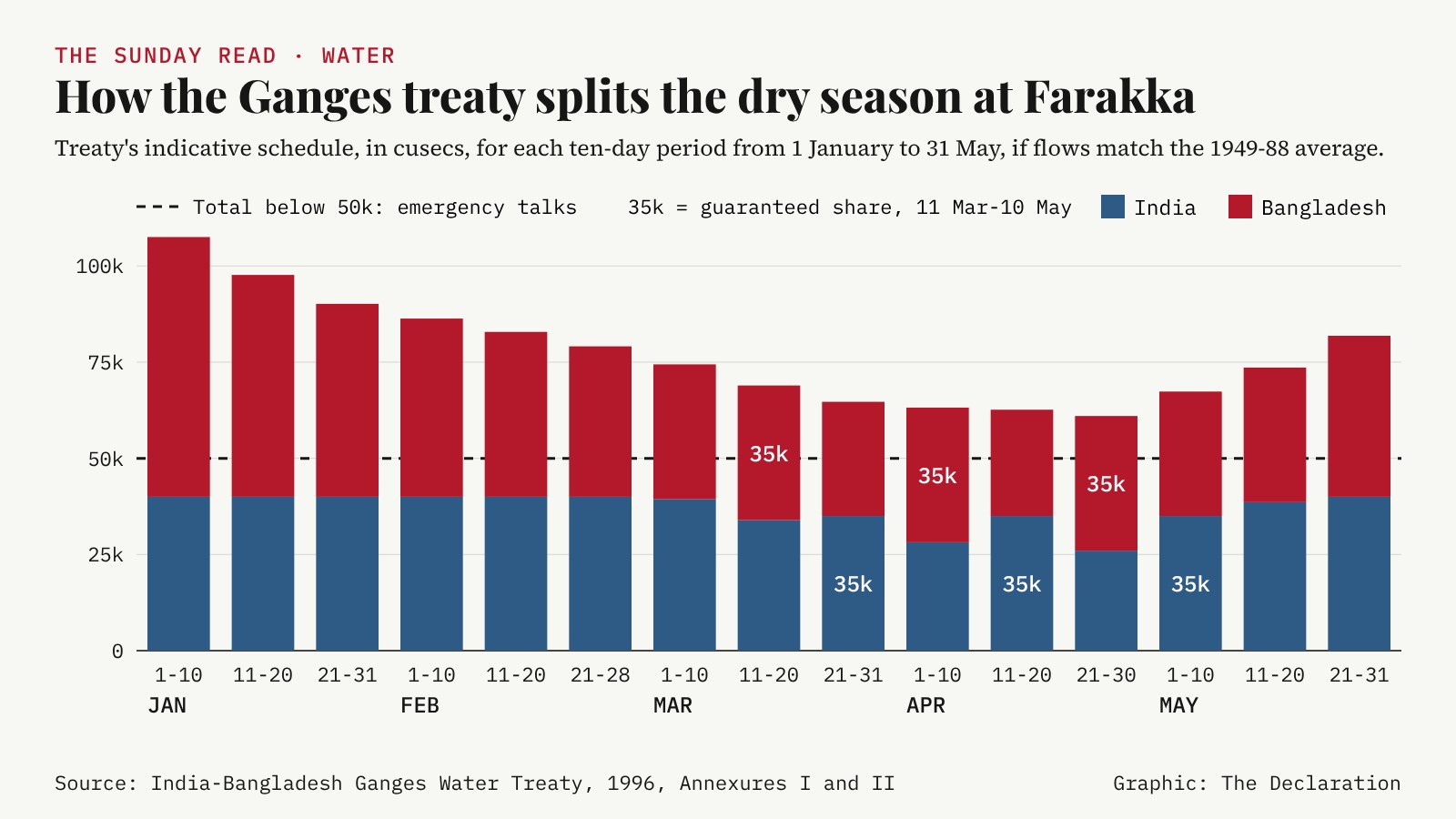
In 27 days, at the end of 12 December, the only water-sharing treaty India has ever signed with Bangladesh runs out. For 30 years the 1996 Ganges Water Treaty has decided, ten days at a time, how the river's dry-season flow at the Farakka barrage in Murshidabad is split between the two countries. Its renewal needs both governments to agree. As of Sunday, there is no new treaty, no announced extension, and not even an agreed date for talks.
Dhaka wants a new treaty with a guaranteed minimum share, and critics there say India has short-changed Bangladesh for decades. The treaty's own record does not bear that out. The Joint Rivers Commission's published data show that India has released Bangladesh's share almost to the cusec for more than 20 years, and in some years more than the formula required. India built Farakka to keep the Hooghly and Kolkata's port alive, its own demand for water in Bihar and West Bengal has grown, and it does not want to promise water that a drier climate may not deliver.
The deadline lands at a difficult moment. Dhaka wants India to extradite Sheikh Hasina, the prime minister who signed the treaty; the consular talks due in Dhaka this week have been postponed; and leaders of Prime Minister Tarique Rahman's party have said good relations with India depend on a new water deal. If the treaty lapses, the 2027 dry season would be the first since 1996 with no legal sharing rule and, unless the two sides agree otherwise, no joint measurement of the river. For eastern India, that touches the water that keeps the Hooghly flowing past Kolkata. For the region, it is a test of whether India can keep a neighbour close while China courts it with river projects of its own.
What is happening
The treaty, signed in New Delhi on 12 December 1996 by H.D. Deve Gowda and Sheikh Hasina, covers 1 January to 31 May each year. Its formula, in Annexure I, depends on how much water reaches Farakka in each ten-day period:
- 70,000 cusecs or less: the flow is split equally.
- 70,000 to 75,000 cusecs: Bangladesh gets 35,000 cusecs and India the balance.
- 75,000 cusecs or more: India gets 40,000 cusecs and Bangladesh the balance.
In the leanest weeks, from 11 March to 10 May, each country is guaranteed 35,000 cusecs in three alternating ten-day periods. If flow at Farakka falls below 50,000 cusecs in any ten-day period, the treaty says only that the two governments "will enter into immediate consultations to make adjustments on an emergency basis". A Joint Committee records daily flows at Farakka, in the feeder canal and at Hardinge Bridge in Bangladesh. Article XII says the treaty "shall remain in force for a period of thirty years and it shall be renewable on the basis of mutual consent". There is no automatic extension.
India's public position has been consistent. The Ministry of External Affairs says all river matters, "including Ganga", go through the Joint Rivers Commission, the bilateral body set up in 1972, and that technical-level talks continue. On 3 November its spokesperson, Randhir Jaiswal, said there was no update on a commission meeting, according to reports of the briefing. The commission last met at ministerial level in August 2022, after a gap of 12 years.
India's case rests on three points that its officials and analysts have made repeatedly. The barrage was built for a national purpose, keeping the Hooghly and Kolkata's port alive, and it is a diversion structure rather than a storage dam, so most of the river carries on into Bangladesh, according to the government and the ORF. India has, by the commission's own data, released what the formula requires. And India's own needs have grown since 1996: Bihar and West Bengal want more water for farms, cities, industry and power plants, and Parliament's committee has asked that any new deal rest on updated data and climate projections rather than on flows recorded between 1949 and 1988.
In Parliament, the Standing Committee on External Affairs, in a report tabled on 30 July 2026, urged the government to start talks "without further delay", using updated hydrological data and climate projections, and to consult Bihar and West Bengal, according to reports.
Bangladesh has asked for talks, and wants more than a rollover. Its water resources minister, Shahiduddin Chowdhury Anee, has said Dhaka wants a new treaty with a "guarantee clause" that secures its share when the river runs low. On 10 November he told Bangladesh's parliament that a high-level technical committee had been formed to negotiate it. In late October, Dhaka said India had not responded to its request to negotiate, according to reports.
Reports differ on New Delhi's plans. One, on 1 November, said changes including a shorter term were being considered, and that renewal was unlikely without a visit by Mr Rahman. Another, on 14 November, said India might let the treaty lapse while keeping Bangladesh's allocation in place for now. The government has confirmed neither.
What the record shows
The claim that India has short-changed Bangladesh is common, especially in Dhaka. The treaty's own record tells a different story.
An analysis of the Joint Rivers Commission's published data for all 450 ten-day periods from 1997 to 2026, by Shafiqul Islam, who directs the water diplomacy programme at Tufts University, was published on Sunday. It found that releases to Bangladesh matched the formula to within one cusec in 384 periods. There was no shortfall of more than one cusec after 2003. Over 30 years, releases above Bangladesh's formula share added up to about 3.66 billion cubic metres, and shortfalls to about 0.14 billion. The treaty's 90 per cent floor was breached once, in early April 1997. The emergency consultation trigger of 50,000 cusecs was crossed only once, in late March 1997. In 2012, India took 21,000 to 32,000 cusecs instead of its 40,000-cusec share from January to early March, and Bangladesh received the difference.
The river also gains water after it leaves Farakka. The median flow recorded at Hardinge Bridge was about 11 per cent higher than the release at Farakka, and that gain is growing, the analysis found. The ORF says tributaries such as the Mahananda and groundwater may explain it.
The same study finds a real problem, but not the one usually alleged. The 35,000-cusec guarantee in Bangladesh's lean-season periods raised the release at Farakka, but on average added very little to what actually arrived at Hardinge Bridge. And Professor Islam found no statistically significant trend in the flow reaching Farakka, though he cautions that the record cannot rule out slow change.
Two conclusions follow. First, the argument is about who carries the risk of a drier river in a hotter climate: Bangladesh wants a guaranteed floor; India does not want to promise water it may not have. The ORF's Nilanjan Ghosh argues that a fixed minimum guarantee would put "a disproportionate hydrological risk" on India. Second, the most immediate loss from a lapse may be the joint measurement. Professor Islam notes that the Joint Committee exists under the treaty, and that without a new instrument, the 2027 dry season would be the first since 1996 without joint readings. His suggestion is that the Joint Rivers Commission, which is older than the treaty, could keep measurement going.
How we got here
India built the Farakka barrage, about 2.2 km long and about 20 km upstream of Bangladesh, to push water down a feeder canal into the Bhagirathi-Hooghly and keep Kolkata's port from silting up. In 2019 the Jal Shakti ministry told the Rajya Sabha that the barrage was serving that objective, diverting 40,000 cusecs, and that the canal also supplies NTPC's Farakka thermal power station. The barrage was commissioned in 1975. Dhaka protested and took the dispute to the United Nations in 1976.
A five-year agreement followed in 1977. It guaranteed Bangladesh at least 80 per cent of its scheduled share in the lean season, according to the Observer Research Foundation. Short-term memorandums in the 1980s followed, but the last of them expired in 1988, and for eight dry seasons there was no sharing arrangement at all. Bangladeshi river campaigners say rivers such as the Gorai, which carries fresh water into the Sundarbans, nearly dried up in those years.
The 1996 treaty replaced the guarantee with a formula tied to the river's average flows between 1949 and 1988. It was signed during Ms Hasina's first term and has long been criticised by her rivals in the Bangladesh Nationalist Party, which now governs. Two other things changed this year. The BJP won West Bengal and Suvendu Adhikari became chief minister on 9 May; it already led Bihar, where Samrat Choudhary took office in April. For the first time, the BJP, which leads the central government, also holds the chief minister's post in both Indian states with a direct stake in Farakka. Mamata Banerjee's opposition as chief minister was widely blamed for stalling the Teesta deal in 2011.
The states' interests are not identical. Bihar argues that the barrage has worsened siltation and flooding upstream. In August, Mr Choudhary asked Mr Adhikari to open all of Farakka's gates as the Ganga rose, and Mr Adhikari promised prompt action, according to reports. A Janata Dal (United) MP from Bihar, Sanjay Kumar Jha, has said the treaty should not be renewed in its present form. The Jal Shakti ministry has told Parliament it found no conclusive evidence that sharing water with Bangladesh has altered the river's shape in West Bengal, according to reports.
How this could change things
Scenario 1: a short extension. If the two governments agree before 12 December to extend the 1996 terms for a few years, the joint measurement and the formula would carry on while a new treaty is negotiated. A former chairman of Bangladesh's National River Conservation Commission, Manjur Ahmed Chowdhury, has proposed renewing the treaty for three to five years as an interim step, arguing that no treaty is worse than a weak one. What drives it: a visit by Mr Rahman, or another high-level meeting, and a decision in both capitals to keep water apart from the Hasina dispute.
Scenario 2: a lapse, with water still flowing. If no agreement is reached, India could keep releasing water by the old formula without a legal obligation, as one report suggested it might. But Bangladesh would lose the treaty's protections, including the 90 per cent floor, and any shortfall in March or April would become a political argument with no agreed numbers to settle it. In that case Dhaka is likely to press its case internationally. Bangladesh joined the UN Water Convention in June 2025, the first South Asian country to do so; India is not a party. The UN Water Conference opens in Abu Dhabi on 8 December, four days before the deadline.
Scenario 3: a long gap. If the Hasina dispute and Bihar's demands harden positions on both sides, the treaty could stay dead for years, as it did from 1988 to 1996. In that case Bangladesh's government is likely to speed up projects it already backs: a $2.8 billion barrage on the Padma, which it approved in May and says will offset the effects of Farakka, and a plan to dredge and embank the Teesta. A senior Chinese Communist Party official told a Dhaka meeting on 4 November that Chinese-backed work on the Teesta was "advancing steadily". The Teesta project lies in northern Bangladesh, not far from the Siliguri Corridor, the narrow strip of land that links India's North-East to the rest of the country. A long water quarrel would be likely to give Beijing more room on India's most sensitive frontier.
For Bengal, all three paths matter. A deal that shrinks India's share in drought years would be felt on the Hooghly and in Kolkata; a breakdown that draws Dhaka closer to Beijing would be felt in north Bengal.
The other side
Some argue that the deadline matters less than it seems. The river will not stop at Farakka on 13 December. The treaty only governs January to May, and India describes the barrage as a diversion structure, not a dam with a large reservoir. Even without a treaty, most of the dry-season flow would continue into Bangladesh.
Some Indian analysts argue that the 1996 deal was more generous than India can now afford, and want a basin-wide approach that also deals with siltation behind the barrage. A renewal on the old terms, they say, would lock India into a formula based on flows from 1949 to 1988 and ignore its own fast-growing demand.
Others in Bangladesh argue that the treaty never protected them enough. They point to the Ganges-Kobadak irrigation scheme, designed for 955 square kilometres and now reaching about 550, according to Bangladesh's state news agency. A former Bangladeshi member of the commission, Malik Fida A. Khan, says India has built "additional dams" upstream. To critics in Dhaka, a rollover would mean accepting a deal they have opposed for 30 years.
And there is the politics. India may see no reason to make concessions to a government that wants Ms Hasina extradited and has invited China closer; Bangladesh's leaders may find a public fight over water useful at home.
What to watch
- Any date for a meeting of the Joint Rivers Commission, at technical or ministerial level, before 12 December.
- A date for Prime Minister Tarique Rahman's visit to India, which has been discussed but not confirmed.
- A new date for the India-Bangladesh consular talks, which were due on 17-18 November and have been postponed.
- Sheikh Hasina's stated plan to return to Bangladesh in December, and any extradition decision in New Delhi.
- 8-10 December: UN Water Conference in Abu Dhabi.
- 12 December: the treaty expires.
- 1 January 2027: the first ten-day period of the dry season. Watch whether joint teams are at Farakka and Hardinge Bridge.
- 11 March to 10 May 2027: the leanest weeks, when the 35,000-cusec guarantee used to apply.
Why India should extend the Ganges treaty now
India should offer Bangladesh, before 12 December, a short extension of the 1996 treaty on its existing terms, for three to five years, with the Joint Committee's measurements continuing. It should say plainly that water is separate from the dispute over Sheikh Hasina, and use the extra time to negotiate a successor that works for Bihar and Bengal as well as for Dhaka.
It costs India little. By the commission's own published record, India has met the formula almost to the cusec for more than two decades. Extending it commits India to nothing it is not already doing. Letting it lapse while still releasing the same water, as one report suggests India might, would give up the goodwill without saving a single cusec.
The alternative helps China. Leaders of Bangladesh's governing party have said good relations depend on a new water deal. Chinese officials are already promoting Chinese-backed work on the Teesta. A lapse would hand Beijing a grievance it could use, close to the Siliguri Corridor. Bangladesh, a party to the UN Water Convention, would also take the dispute to forums where India has less control.
It is India's own argument, upstream. On the Brahmaputra, India is the downstream country, and it is asking China for data, transparency and rules. A record of honouring a water treaty with the country below it strengthens that case. Walking away from one weakens it.
Bengal needs the formula too. The treaty protects India's own share as much as Bangladesh's: the 40,000 cusecs that feed the Hooghly, Kolkata's port and the Farakka power station. A breakdown makes every future negotiation less predictable for Kolkata.
Now is the moment to fix the treaty's weaknesses. With the same party in power in New Delhi, Kolkata and Patna, India can settle its own position in a way it could not for the Teesta. Bihar's concerns about silt and floods deserve a proper study, not a veto; the ORF has called for a sediment-budget analysis before blame is assigned. A successor treaty should replace the fixed guarantee Bangladesh wants with something fairer to both sides: a shared rule for cutting both countries' shares in a drought, and near real-time publication of the data.
There are real costs. An extension postpones the larger share that Bihar and West Bengal want. It will be read by some as a reward to a government in Dhaka that has been hostile to India. But the choice is not between a perfect treaty and the old one. It is between keeping the only working water agreement in the neighbourhood and entering the 2027 dry season with none. India should keep it.
Sources
- Original documentTreaty between the Government of Bangladesh and the Government of India on Sharing of the Ganga/Ganges Waters at Farakka, 12 December 1996 (full text with Annexures I and II, ADB Law and Policy Reform repository)
- Original documentUnited Nations in Bangladesh: press release on Bangladesh joining the UN Water Convention, June 2025
- Original documentUnited Nations (UN DESA): 2026 UN Water Conference, Abu Dhabi, 8-10 December 2026
- Original documentRajya Sabha: Ministry of Jal Shakti answer on the Farakka Barrage Project, 25 November 2019
- PRS Legislative Research: summary of the Standing Committee on External Affairs report 'Future of India-Bangladesh Relationship' (December 2025)
- The Daily Star: Do Bangladesh and India still need the Ganges Treaty? (Shafiqul Islam)
- Observer Research Foundation: The Ganges Treaty at 30: Why water sharing is not enough (Nilanjan Ghosh)
- The Week: Ganga water treaty nears expiry: Decoding the stakes for India-Bangladesh talks amid strained ties
- The Business Standard: Working to sign deals for fair shares of water from Teesta, Ganges, other rivers: Anee
- The Business Standard: India-Bangladesh Ganges water treaty terms may face significant changes: Report
- Dainik Jagran English: Ganges Water Treaty Renewal: India and Bangladesh face crucial diplomatic challenge
- Dawn (AFP): Bangladesh presses India before Ganges water treaty expires
- Prothom Alo: Special interview of Manjur Ahmed Chowdhury: Relations also influencing Ganges treaty talks
- Outlook: Farakka, floods and river sharing: Why Bihar wants a new Ganga water deal
- Deccan Chronicle: Farakka treaty shouldn't be renewed in Bihar's interest: JD(U)'s Sanjay Jha
- Asianet Newsable: Bihar floods: CM Choudhary urges West Bengal's Adhikari to open Farakka gates
- Education Post: India ties hinge on new Ganges treaty, warns Bangladesh minister
- The Kashmir Images (PTI): Initiate discussions with B'desh on Ganga Water Treaty without further delay: Par panel to govt
- The Business Standard: India wants 'positive, constructive' ties with Bangladesh: Jaiswal
- The Business Standard: China seeks stronger political, economic ties with Bangladesh: Liu
- Scroll: Bangladesh's $2.8 billion Padma barrage
- The Wire: As the Ganges treaty approaches expiry, can India and Bangladesh separate water security from political distrust?
This story was researched and drafted with AI assistance and reviewed by an editor before publication. Spotted an error? Tell us. Corrections log.