Israel's opposition unites behind Eisenkot as Herzog opens talks on a new government
Five opposition leaders will recommend the former army chief for prime minister, but they rule out a coalition with Arab-led parties and remain short of a majority.
Israel's main opposition leaders agreed on Tuesday to recommend former army chief Gadi Eisenkot as prime minister. That sets up a contest with Benjamin Netanyahu as President Isaac Herzog begins talks on Wednesday on who should get the first chance to form a government after last week's inconclusive election.
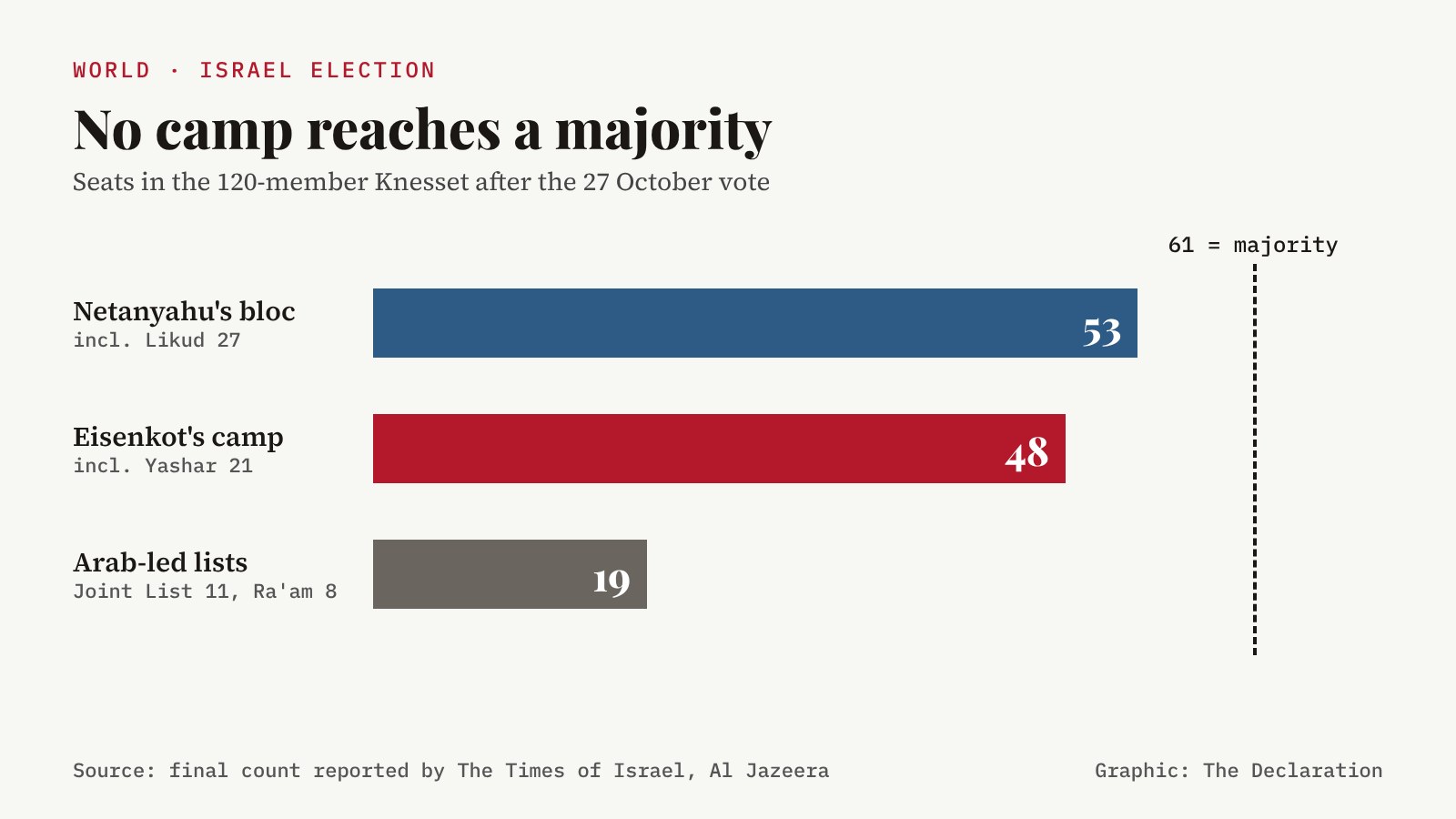
Neither camp has a clear route to the 61 seats needed in the 120-member Knesset. In the final count from the 27 October vote, Netanyahu's right-wing and religious bloc won 53 seats, Eisenkot's opposition camp 48 and two Arab-led lists 19, The Times of Israel reported. At Tuesday's meeting the opposition leaders ruled out a coalition with the Arab-led parties, according to the Israeli news site Ynet, and they did not say how else they would reach a majority.
What happened
Eisenkot, who heads the Yashar party, met former prime minister Naftali Bennett, Yair Lapid of Yesh Atid, Yair Golan of The Democrats and Avigdor Liberman of Yisrael Beytenu in Herzliya. It was their first joint meeting since the election. In a joint statement they said all their parties would recommend Eisenkot to the president and that negotiating teams would start drafting policy guidelines and coalition agreements at once. They promised to replace Netanyahu's coalition with what they called a "national emergency government", Al Jazeera reported.
"We don't have time – we must act with great urgency," Bennett said, according to Al Jazeera. Lapid said Netanyahu and his allies "have caused enough damage", Ynet reported.
The leaders backed four principles set out by Eisenkot. According to Al Jazeera, these include that every party in the government must recognise Israel as a Jewish state and call Hamas a terrorist group. Those conditions could shut out some of the Arab-led parties. Ynet reported that when Golan asked whether the decision not to work with the Arab parties was final, Liberman answered "yes" and Eisenkot and Bennett nodded. The leaders did not rule out working with the ultra-Orthodox parties.
They also did not agree on who should replace Knesset Speaker Amir Ohana, a Netanyahu ally. Ynet reported that Bennett and Liberman want Lapid, while Eisenkot prefers someone from his own party and asked for the decision to wait until Sunday or Monday. Replacing the speaker needs 61 votes.
The arithmetic
Election results, as reported by The Times of Israel and Al Jazeera:
- 120 seats in the Knesset; 61 needed for a majority
- 53 for Netanyahu's bloc, including 27 for his Likud party, the largest single party
- 48 for the opposition camp, including 21 for Eisenkot's Yashar
- 19 for the Arab-led lists: the Joint List with 11 and Ra'am with 8
- 77.9% turnout, the highest in decades
Without the Arab-led parties, the opposition would need defections from Netanyahu's side. Ynet reported that Eisenkot is looking to the ultra-Orthodox parties, possibly for a minority government. But even the seven seats of United Torah Judaism would take the opposition only to 55. The analyst Nimrod Flaschenberg told Al Jazeera he doubted such a defection would be enough without Arab support. Liberman wrote that a stable government was possible "without Ra'am or the Joint List", Ynet reported.
The Arab-led parties are signalling that they are willing to help. The Times of Israel reported that the Joint List plans to recommend an anti-Netanyahu candidate, presumably Eisenkot, and has offered support from outside the government, and that Ra'am is also expected to back him. Yousef Jabareen, head of the largest Arab-led party in the new Knesset, said the opposition must accept "political reality", according to Al Jazeera. Golan is the only opposition leader openly backing an alliance with them.
Background
Netanyahu, 77, is Israel's longest-serving prime minister. On Monday he called for a "broad national government" under his leadership, citing Likud's first place. He has ruled out governing with the Arab-led lists, which he accuses of supporting terrorism. No opposition leader has said they would join him, Al Jazeera reported. Netanyahu is on trial on corruption charges, which he denies, and has asked Herzog for a pardon. The International Criminal Court has issued a warrant for his arrest over the war in Gaza; Israel rejects the court's jurisdiction.
Likud has accused the Arab-led parties of stealing the election with foreign help, without offering evidence. Police have said the claims have no basis, and the Central Elections Committee's acting director general called reports of a stolen election "entirely unfounded", The Times of Israel reported. A Shin Bet inquiry into possible foreign interference continues.
Arab citizens make up about a fifth of Israel's population. In 2021 Ra'am became the first independent Arab party to join an Israeli coalition, the 2021-22 government led by Bennett and Lapid.
What happens next
Herzog is due to receive the official results from the committee's chairman, Justice Noam Sohlberg, at noon on Wednesday (3:30 pm IST) and to begin meeting party delegations at 5 pm (8:30 pm IST), the Jewish News Syndicate reported. The meetings are expected to continue on Thursday and could run into Friday. Unusually, he will start with the smaller parties.
Herzog will ask each party whom it recommends, then choose a lawmaker, not necessarily a party leader, to try to form a government. That person has 28 days, which the president can extend by 14. If they fail, Herzog can turn to someone else. On Sunday he urged party leaders to "stop climbing trees, and face the reality" and to find "creative solutions to prevent another election", The Times of Israel reported. The new Knesset is sworn in on 10 November.
Events abroad could also shift the balance. Al Jazeera noted that the results of Tuesday's US midterm elections, and any new fighting with Iran, could change the calculations. The analyst Yossi Mekelberg suggested that a new emergency could help Netanyahu draw opposition figures into a unity government.
Why it matters for India
India has close defence, technology and trade ties with Israel, and Israel is part of the India-Middle East-Europe Economic Corridor that New Delhi has promoted since 2023. Whoever governs next will decide Israel's policy on the stalled Gaza ceasefire and on Iran. The US-Iran standoff has already disrupted shipping through the Strait of Hormuz, and an Indian seafarer was killed in an attack on an Indian-flagged vessel off Oman this week.
Sources
- Al Jazeera: Israel's opposition leaders back Eisenkot to oust Netanyahu
- Ynet: Eisenkot's bloc backs first mandate bid, rules out Arab-party cooperation
- Al Jazeera: Israel political deadlock leaves Netanyahu's future hanging in the balance
- The Times of Israel: 'Stop climbing trees': Herzog urges party leaders to avoid another election
- Cleveland Jewish News (JNS): Herzog to receive official results, start consultations with Knesset factions
- The Times of Israel: With all votes counted, Netanyahu's bloc at 53 seats, Eisenkot's 48, Arab parties 19
This story was researched and drafted with AI assistance and reviewed by an editor before publication. Spotted an error? Tell us. Corrections log.