China is using supply chokeholds to slow India's rise, US congressional panel says
The US-China Economic and Security Review Commission's annual report has a chapter on India documenting curbs on rare-earth magnets, battery technology and engineers, cut-price drug ingredients and a growing two-front risk with Pakistan.
China is "actively working to suppress India's rise across multiple domains", and its sharpest tool is economic, a bipartisan commission that advises the US Congress said on Wednesday in its 2026 annual report. The US-China Economic and Security Review Commission's chapter on India, titled "China's Other Front", documents how Beijing has held back rare-earth magnets, battery technology, fertilisers, tunnel-boring machines and Chinese engineers bound for India, and cut prices of drug ingredients just as new Indian factories opened.
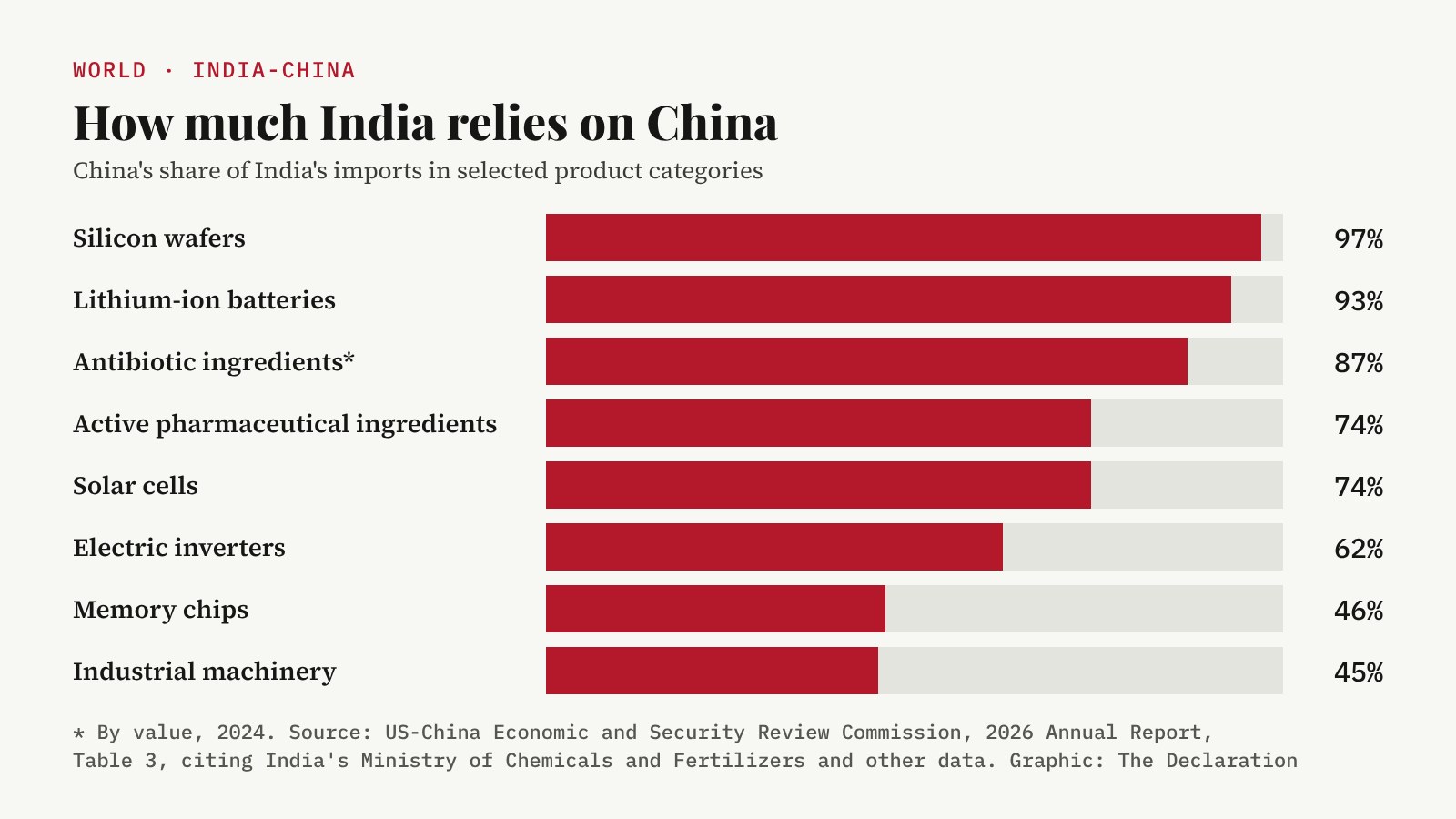
The report, released in Washington on 18 November, says India's dependence on Chinese inputs "has deepened even as its de-risking measures multiplied". China supplies 97% of the silicon wafers India imports, 93% of its lithium-ion batteries, 87% by value of its antibiotic ingredients and 74% of its active pharmaceutical ingredients and solar cells, according to a table in the chapter that draws partly on India's own Ministry of Chemicals and Fertilizers.
What the report says
The commission lists specific Chinese measures. In spring 2025, it says, China restricted sales of specialised fertilisers and delayed tunnel-boring machines for the Mumbai-Ahmedabad bullet train. After imposing global licensing for rare earths in April 2025, Beijing "slow-walked" approvals for Indian firms; shipments to Indian carmakers were held in Chinese ports while those for German and US carmakers were approved. Those curbs were lifted in August 2025, ahead of Prime Minister Narendra Modi's visit to China for the SCO summit.
From January 2025, the report says, China restricted the movement of specialised engineers and equipment to Foxconn's Indian iPhone factories, and by July 2025 Foxconn had recalled hundreds of Chinese engineers. Export controls on battery-making equipment announced in October 2025 have delayed Indian clean-energy production, it adds, citing reports that Reliance Industries struggled to obtain Chinese technology for its battery gigafactory in Gujarat.
In pharmaceuticals, the commission says Chinese producers cut prices of 41 drug ingredients and key starting materials by 40-50% in 2025, which hit the two largest plants built under India's production-linked incentive scheme, in Himachal Pradesh and Telangana. India has responded with import restrictions and anti-dumping investigations, it notes.
The commission calls China's demand that some Indian firms certify that Chinese-supplied rare-earth magnets would not be re-exported to the United States "the most novel and strategically significant coercive tool". China suspended that requirement as part of its trade truce with Washington, the report says, but it warns the lever could be used again.
The border, Pakistan and the Indian Ocean
The report calls the unresolved border "the central fault line" between the two countries. It says the patrolling arrangements agreed since October 2024 have eased immediate tensions but not resolved the dispute, while China keeps building airfields, railways and logistics networks across the Tibetan plateau. It quotes a witness at its February hearing warning of "significant inadvertent conventional escalation" if either side misjudges a move.
China's military partnership with Pakistan "has made a two-front contingency an increasingly critical concern for India", the commission says, citing the May 2025 India-Pakistan conflict as a demonstration of how China could strengthen Pakistan in a crisis without fighting itself. At sea, it describes Chinese survey and research vessels operating near India's coast, and says a Chinese survey ship reportedly entered the Bay of Bengal in May 2025 as India-Pakistan tensions mounted. It says China has begun "renaming" undersea features in the Indian Ocean with Mandarin names, a tactic it compares to Beijing's approach in the South China Sea.
What it means for India and Bengal
For the rivers that matter most to eastern India and Bangladesh, the report says China's control of the Tibetan plateau is "creating a new source of potential strategic leverage" over downstream states. It notes that the Yarlung Tsangpo project on the upper Brahmaputra is now under construction, and that China suspended sharing of Brahmaputra flood-season data during the 2017 Doklam standoff.
On Bangladesh, the report says Dhaka's interim government deepened security cooperation with Beijing and Islamabad, approved a plan to buy Chinese J-10CE fighters and joined a China-Bangladesh-Pakistan trilateral mechanism launched in June 2025. It says China has committed nearly $40 billion in Belt and Road financing to Bangladesh since 2016, of which only $4.5 billion had been disbursed by 2023, and lists Chittagong among the Indian Ocean ports China has financed.
The trade numbers explain the stakes. India's goods deficit with China reached $106.8 billion in 2025, more than double its 2020 level and over 41% of India's total trade deficit, the report says; imports from China rose 21.6% in the first half of 2026. In March 2026 India eased its 2020 curbs on Chinese investment for stakes of up to 10%, which the commission describes as "a tactical shift to selective economic re-engagement" rather than a change in India's underlying distrust.
What they are saying
The commission says India's rivalry with China "is driven by its own strategic interests, not by alignment with Washington", and that India will "guard its strategic autonomy". New Delhi has consistently said peace on the border is necessary for normal relations, a position the report attributes to External Affairs Minister S. Jaishankar.
China's foreign ministry had not commented on the report by early Thursday. When the Pentagon published a report on China's military last December that also discussed India, foreign ministry spokesperson Lin Jian said the border was a matter between China and India and that Beijing objected to "any country passing judgment" on it, and that China handles its India relations "from a strategic height and a long-term perspective". Beijing has said earlier export curbs were for technical reasons, according to the commission. India's Ministry of External Affairs had not commented on the report by early Thursday.
What happens next
The commission's recommendations are advisory. For India, the most direct is a proposed US "Comprehensive Critical Drug Diversification" programme built around US-India cooperation, with long-term US government purchase commitments for medicines made with trusted ingredients and support for drug-ingredient plants in India, conditional on falling reliance on Chinese starting materials and matching Indian funds. It also urges closer US-India intelligence and surveillance sharing on Chinese naval and submarine activity in the Indian Ocean, and a senior US-India channel on the succession of the Dalai Lama.
China's suspension of its October 2025 rare-earth and battery export controls now runs to 10 January 2027, under the trade truce between Washington and Beijing. The report lands as US President Donald Trump, Chinese President Xi Jinping and Russian President Vladimir Putin prepare to meet in Shenzhen on Thursday.
Key numbers
- 97%: China's share of India's silicon wafer imports
- 93%: share of lithium-ion battery imports
- 74%: share of active pharmaceutical ingredient imports
- $106.8 billion: India's goods trade deficit with China in 2025
- 41: drug ingredients whose prices Chinese producers cut by 40-50% in 2025
Sources
- Original documentUS-China Economic and Security Review Commission: 2026 Annual Report, Chapter 3, 'China's Other Front: India and the Future of U.S. Strategy in the Indo-Pacific' (PDF)
- Original documentUS-China Economic and Security Review Commission: Comprehensive list of 2026 recommendations (PDF)
- Original documentUS-China Economic and Security Review Commission: 2026 Annual Report to Congress (release page, 18 Nov 2026)
- Original documentFederal Register: USCC notice of open public event for the 2026 annual report release
- The Week: China slams US for 'irresponsible' report on border tensions with India (Dec 2025)
- APA Engineering: China extends export control suspension to January
This story was researched and drafted with AI assistance and reviewed by an editor before publication. Spotted an error? Tell us. Corrections log.