The dam India cannot see: China's Brahmaputra mega-project and the missing river data
China is building the world's largest hydropower scheme just upstream of Arunachal Pradesh, and India says it has received no river data since 2022. Why the project matters more than the 'water bomb' headlines suggest, and why India needs its own dam on the Siang.
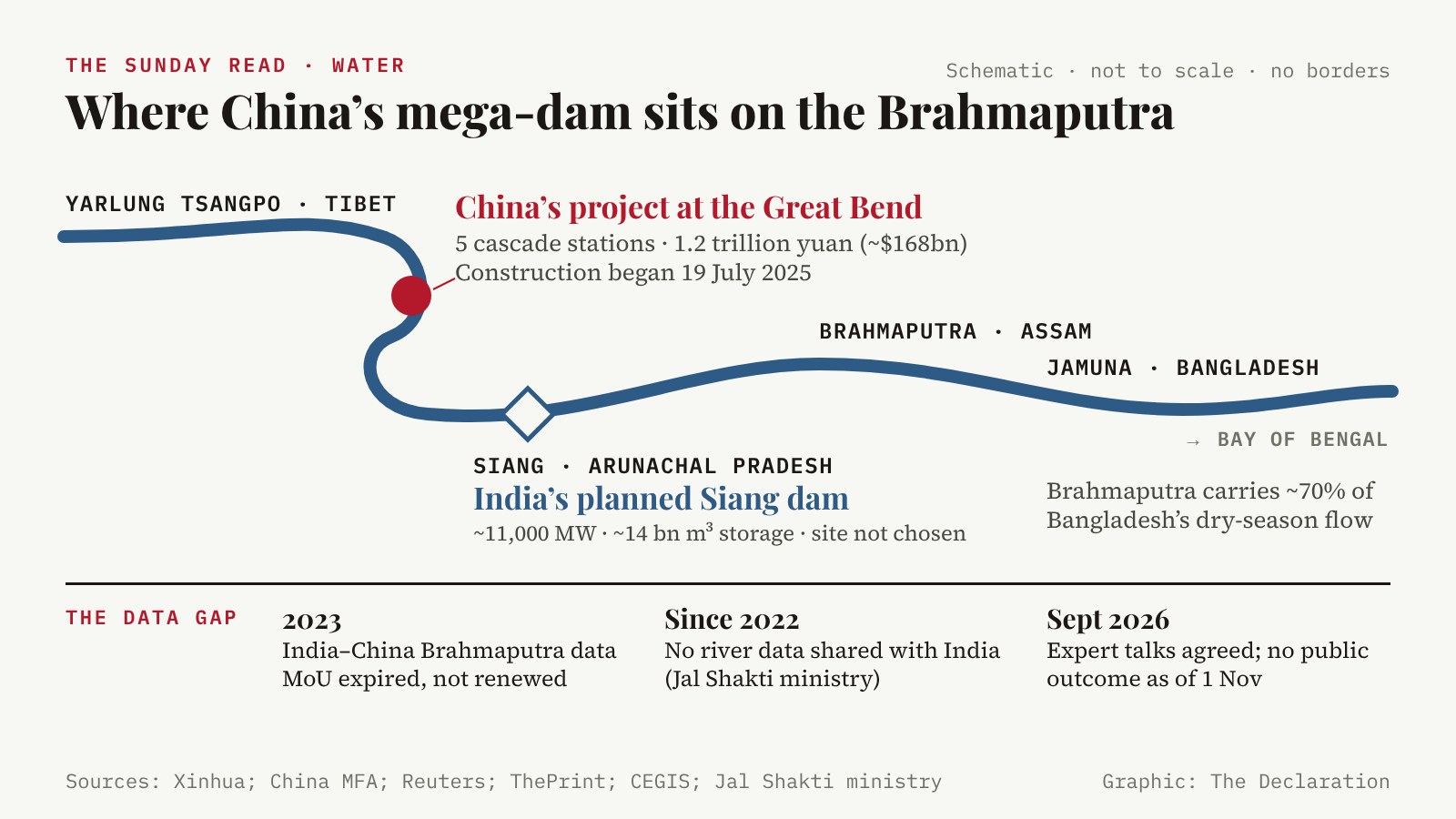
In the gorges of south-eastern Tibet, a short distance upstream from where the Yarlung Tsangpo turns south and becomes the Siang in Arunachal Pradesh, China is building what is expected to be the largest hydropower project in the world. Premier Li Qiang announced the start of construction at a ceremony in Nyingchi on 19 July 2025. According to Chinese state media, the scheme has five cascade power stations, will cost about 1.2 trillion yuan (about $167.8 billion), and will be built and run by a new state company, China Yajiang Group, created for the purpose.
Fifteen months later, the project rarely makes India's front pages. Yet it sits on the main river of India's north-east, which according to Bangladeshi researchers carries about 70 per cent of the dry-season flow passing through Bangladesh. It sits on an active fault. And it is going up while India's water ministry says China has not shared flood-season river data with India since 2022. The agreement that used to guarantee that data expired in 2023 and has not been renewed.
That combination is why a construction site few people will ever see could shape the region for decades: an engineering project of enormous scale; two downstream countries with no treaty and little information; and a diplomatic thaw that has so far produced promises about the river rather than data.
What is happening
Beijing approved the project in December 2024; Chinese state media reported the approval on 25 December. Since then, Beijing has said little about the design beyond the headline figures. Reports since 2024 have described a cascade that uses the steep drop of the Great Bend, where the river loops around Namcha Barwa before plunging towards India. Annual output is put at about 300 billion kilowatt-hours, roughly three times that of the Three Gorges Dam. According to Chinese state media, the electricity will mainly be sent out of Tibet, with some used locally. No completion date has been officially announced.
Beijing's position has been consistent. On 27 December 2024, foreign ministry spokesperson Mao Ning said the project "will not have adverse impacts on the downstream areas" and that China would keep communicating with downstream countries through existing channels. Wang Lei, then China's chargé d'affaires in New Delhi, later wrote in a newspaper article that the dam "does not consume water" and that China "does not and will never seek 'water hegemony'".
India's response has run through diplomatic channels. On 30 December 2024, India "registered its concerns" with China, according to a written reply in the Rajya Sabha by Minister of State for External Affairs Kirti Vardhan Singh on 27 March 2025. On 3 January 2025, MEA spokesperson Randhir Jaiswal said China had been urged to ensure that the interests of downstream states "are not harmed by activities in upstream areas". He added that India, "as a lower riparian state with established user rights", would monitor the project and take measures to protect its interests. External Affairs Minister S. Jaishankar raised the dam with Foreign Minister Wang Yi in August 2025, according to India's foreign ministry.
On the Indian side of the border, the government's answer is a dam of its own. The Siang Upper Multipurpose Project (SUMP), to be built by the state-owned NHPC, is planned at about 11,000 MW. An Indian government analysis, according to reports in August 2025, put its storage at about 14 billion cubic metres, enough to release water in the dry season and to absorb a sudden surge from upstream. According to reports on 27 October, the project's site has still not been chosen. Survey work has been stopped by protests from Adi and Galo communities, whose villages would be flooded.
How we got here
The Yarlung Tsangpo rises in western Tibet and runs east for about 1,600 km across the plateau. It then turns sharply at the Great Bend and enters Arunachal Pradesh as the Siang. In Assam it joins the Dibang and Lohit to become the Brahmaputra, and in Bangladesh it becomes the Jamuna before meeting the Padma and the Meghna on the way to the Bay of Bengal. Of the river's roughly 2,880 km, more than half lies on the Tibetan plateau.
There has never been a water-sharing treaty on this river. Instead, India and China built a thin layer of technical cooperation:
- 2002: a memorandum of understanding (MoU) under which China provides flood-season data from its Tibetan gauging stations, from 15 May to 15 October each year. It was renewed several times, most recently for a term that ended in 2023.
- 2005: a similar MoU for the Sutlej.
- 2006: an Expert Level Mechanism (ELM) on trans-border rivers, which meets to discuss the data and other river issues.
The arrangement has proved fragile. After the 2017 Doklam standoff, China stopped sending data, citing upgrades to its stations, and resumed on 15 May 2018. After the 2020 clashes in eastern Ladakh, relations froze again. The Sutlej MoU expired in 2020 and the Brahmaputra MoU in 2023, and neither has been renewed. India's Jal Shakti ministry has said China has not shared hydrological data with India since 2022.
The thaw that followed the October 2024 border agreement brought the river back into diplomacy, but mostly as a promise:
- January 2025: after Foreign Secretary Vikram Misri's visit to Beijing, the two sides agreed to hold an early ELM meeting, according to the Rajya Sabha reply.
- 19 August 2025: at the 24th round of Special Representatives talks in New Delhi, the Chinese foreign ministry's list of agreed points said the two sides would "keep communication on the renewal of relevant MoUs". It also said that "the Chinese side agreed to share hydrological information during emergency situations based on humanitarian considerations".
- 27 May and 6 August 2026: at the 35th and 36th meetings of the border affairs working mechanism (WMCC), India pressed for an early ELM meeting and for technical details of upstream projects. China's own readout of the August meeting does not mention rivers.
- 25 August 2026: at the 25th round of Special Representatives talks in Beijing, the two sides "agreed to hold the next meeting of the China-India Expert-Level Mechanism on Trans-border Rivers in September". They also agreed to "maintain communication on issues including hydrological data sharing, and renewal of relevant MoUs", according to China's foreign ministry.
Xi Jinping visited New Delhi for the BRICS summit on 12-13 September and held talks with Prime Minister Narendra Modi. Reported accounts of that meeting focused on trade and the border. The Declaration could not find a public statement from either government confirming that the September ELM meeting took place, or what it agreed.
Why it has stayed out of the spotlight
Part of the reason is physical. The site is in one of the most remote and tightly controlled parts of China, and almost nothing about the design has been made public. Bangladesh's water ministry wrote to China in March 2025 asking for the project's environmental impact assessment, feasibility study, climate impact assessment and disaster impact assessment. Syeda Rizwana Hasan, then an adviser to Bangladesh's interim government, said Dhaka had received no reply.
Part of it is timing. Since late 2024, both governments have been invested in normalising relations: border patrolling arrangements, resumed flights, a leaders' summit. A dispute over a river is an awkward fit for that story.
And part of it is the shape of the debate. Indian coverage has tended to swing between two slogans: the dam as a "water bomb", and the dam as harmless run-of-the-river engineering. The questions that actually decide how much it matters sit between them, and they are technical: where the water comes from, when it arrives, what happens to the silt, and who gets to know.
There is also no forum where those questions must be answered. Neither India nor China is party to the 1997 UN Watercourses Convention, the main global treaty on shared rivers. China voted against it, and India abstained.
The question that decides the stakes: how much of the river does China control?
The honest answer is that the published numbers disagree, and the disagreement is itself part of the story.
Figures from Chinese researchers, cited by Nilanjan Ghosh of the Observer Research Foundation, put the river's annual outflow from China at about 31 billion cubic metres. That is a small fraction of the roughly 606 billion cubic metres that flow past Bahadurabad in Bangladesh each year. Most of the Brahmaputra's water is monsoon rain that falls south of the Himalayan crest, in Arunachal, Assam, Bhutan and Bangladesh. That is why many Indian hydrologists argue that fears of China "turning off" the river are overstated.
The Indian government analysis points to a much larger figure, according to reports. It estimated that China could divert as much as 40 billion cubic metres a year, "just over a third" of the annual flow at a key border point. That implies a little under 120 billion cubic metres a year crossing into India, nearly four times the Chinese-cited figure. Part of the gap may lie in where the water is measured. Rainfall on the plateau averages a few hundred millimetres a year, but the Great Bend around Medog receives about 3,000 mm, according to the figures Ghosh cites, and the dam sits in that wet stretch just above the border. With no shared data, each side is arguing from its own numbers. The Indian analysis also said dry-season flows could fall by up to 85 per cent under some conditions, and that Guwahati could see a 25 per cent cut in water supply. With SUMP built, that cut would fall to 11 per cent.
The dry season is where the upstream share matters most, which is why the Indian analysis focuses on it: when the monsoon-fed tributaries shrink, water arriving from Tibet makes up a larger part of what is left. Bangladesh is even more exposed. Malik Fida A Khan of the Bangladeshi research institute CEGIS says the Brahmaputra supplies about 70 per cent of the dry-season flow of the river system passing through the country. More than half the sediment Bangladesh receives also arrives through it, and that silt builds and sustains the delta.
Three further risks do not depend on how much water China takes:
- Peaking. Even a dam that stores little can change the river's daily rhythm by holding water back and releasing it to meet peaks in electricity demand. Analysts have warned that such "hydropeaking" alters downstream flow, water temperature and the movement of sediment.
- Earthquakes. In June 2026, Chinese geologists writing in the journals Sedimentary Geology and Tethyan Geology identified the active Paizhen Fault directly beneath the project area, according to reports. They warned that a saturated reservoir combined with fault movement could destabilise its slopes. The 7 January 2025 earthquake near Tingri in Tibet killed at least 126 people. China measured it at magnitude 6.8; the US Geological Survey put it at 7.1. Afterwards, a Tibetan emergency official said five of 14 hydropower dams inspected had problems, including cracks, and three were emptied, according to reports.
- Information. Without data, an Indian flood forecaster cannot tell a natural flood from a release, or a landslide-dammed lake from normal flow. China's 2025 promise to share data "during emergency situations" leaves Beijing to decide what counts as an emergency.
How this could change things
Three broad paths are plausible. Which one the region takes will be decided less by engineering than by the politics of information.
1. Managed coexistence. If the expert mechanism meets regularly and the Brahmaputra data MoU is renewed before the flood season begins on 15 May 2027, the dam becomes a managed risk. India and Bangladesh would get gauge readings and, ideally, advance notice of reservoir operations. What drives this path is the thaw itself: both capitals have reasons to keep relations steady, from trade to flights to summitry. In that world, the dam's main downstream effect would be on daily flows and silt, which are real but slow and negotiable.
2. Information as leverage. If relations sour again, the record suggests data will be the first thing to go, as it did after Doklam in 2017 and after the Ladakh clashes. Uttam Kumar Sinha of the Manohar Parrikar Institute for Defence Studies and Analyses has argued that China prefers arrangements, mechanisms and MoUs because they can be suspended or revoked as conditions change. In this scenario the dam's significance is less about water than about uncertainty: a lever that need never be pulled to have an effect. Indian planners are clearly considering this possibility. According to reports, officials have discussed keeping 30 per cent of SUMP's reservoir empty at all times to absorb a surge from upstream.
3. A dam race with domestic costs. If India decides it cannot rely on Chinese goodwill, SUMP becomes a strategic necessity, and the costs fall on Arunachal. According to reports, at least 16 Adi villages would be lost to the reservoir, directly affecting about 10,000 people; community leaders put the number affected at more than 100,000. Reports have put the project's cost at nearly ₹1.5 trillion. A second giant dam in the same seismic belt would also add risks of its own. In this scenario, the most immediate effect of China's project is on India's internal politics: a conflict between national security arguments and tribal land rights in a frontier state.
Bangladesh's choices will shape all three paths. Dhaka already faces the expiry of the Ganges Waters Treaty with India on 12 December. On the Brahmaputra it is downstream of both China and India, so it has reasons to press for basin-wide data sharing rather than two separate bilateral arrangements. Whether it does so, and which capital it leans on, is one of the less discussed variables in eastern South Asia's water politics.
The other side
Beijing's case is that the project is clean energy, essential to China's climate commitments, and designed so as not to harm anyone downstream. It says the project has undergone rigorous scientific study of safety and environmental protection, that a run-of-the-river scheme passes water through rather than storing it, and that China has signed more than 50 water agreements with its neighbours.
Many Indian water specialists also caution against alarm. Their argument rests on the hydrology above: most of the Brahmaputra's water is generated in India and Bangladesh, the Tibetan stretch receives relatively little rain, and a scheme built for power generation has an incentive to keep water moving through its turbines, not to hold it back. On this view, the larger risks to Assam's floods and erosion lie downstream, in deforestation, embankments and land use, and the "water bomb" framing distracts from them.
SUMP faces its own critics. Adi and Galo residents say they were not properly consulted and stand to lose ancestral land. The Congress has opposed the project. Some analysts argue that answering one mega-dam with another multiplies the very risks it is meant to manage. Arunachal Chief Minister Pema Khandu, who has called the Chinese project a "ticking water bomb", argues the opposite: that a reservoir on the Indian side is the only real protection.
Both sides' central claims are hard to test, and that may be the most important point. Without published designs, impact assessments or river data, neither Beijing's reassurances nor New Delhi's worst-case scenarios can be independently checked.
What to watch
- The September ELM meeting: whether either government confirms it took place, and whether data sharing resumes.
- Before 15 May 2027: whether the Brahmaputra data MoU is renewed before the next flood season.
- The next round of Special Representatives talks: whether rivers move from a line about "communication" to a concrete commitment.
- SUMP: completion of NHPC's pre-feasibility report and a decision on the site (Uggeng, Dite Dime or Parong), and how talks with Adi and Galo communities proceed.
- Medog construction: milestones reported by Chinese state media or China Yajiang Group, especially river diversion or reservoir works.
- Dhaka: whether Beijing ever answers Bangladesh's March 2025 request for impact studies.
- Monsoon 2027: whether Assam's flood forecasters receive upstream readings.
Key numbers
- 1.2 trillion yuan (about $167.8 billion): official investment (Chinese state media)
- 5: cascade power stations
- About 300 billion kWh a year: reported annual output
- 2023: year the Brahmaputra data MoU expired
- 2022: last year China shared Brahmaputra data with India, according to India's Jal Shakti ministry
- Up to 85 per cent: possible fall in dry-season flow in an Indian government scenario (reports)
- About 14 billion cubic metres: planned storage of India's Siang project (reports)
- About 70 per cent: Brahmaputra's share of dry-season flow through Bangladesh (CEGIS)
Why India needs the Siang dam
This section sets out The Declaration's view.
For all the uncertainty in the numbers, one fact is not in dispute: India is the downstream country, and on this river it has no treaty, no veto and, for now, no data. Every safeguard India once relied on, from the data agreement to the expert meetings to the goodwill of a thaw, exists at Beijing's discretion, and data has been cut off before. A responsible state cannot stake the safety of Arunachal and Assam on promises it has no means to enforce. That is the core case for the Siang Upper Multipurpose Project, and it is a strong one.
It is India's only insurance against a sudden release. A cascade of the size China is building, on an active fault, upstream of Indian towns, creates a risk India did not choose and cannot inspect. A reservoir on the Siang with storage of about 14 billion cubic metres, with officials reportedly considering keeping 30 per cent of it empty, is the one tool that can absorb a surge from upstream, whether it comes from an operating decision, a landslide or an earthquake. According to reports, India's own analysis found that with the dam in place, the possible cut in Guwahati's water supply falls from 25 per cent to 11 per cent. No diplomatic instrument on offer delivers that protection.
It protects the dry season, when the river is most vulnerable. The greatest exposure is not the monsoon flood but the lean months, when water arriving from Tibet makes up more of what is left. Storage that can be released between November and May gives India, and indirectly Bangladesh, a buffer against any change in upstream flows, deliberate or not.
It strengthens India's hand, not just its defences. Under international water law, existing uses of a river are among the factors weighed when its waters are shared. As the MEA has stressed, India is a lower riparian state with established user rights to the Brahmaputra's waters. A major Indian project on the Siang turns those rights into facts on the ground. It also gives New Delhi something it currently lacks in talks with Beijing: leverage. An upstream power that knows its downstream neighbour can manage the river's flow has more reason to share data and coordinate.
It answers a real energy and development need. At about 11,000 MW, it would be India's largest hydropower project, according to reports, and a major source of clean power. It would also bring roads, jobs and flood management to one of India's least developed regions.
None of this makes the concerns of the Adi and Galo communities less legitimate. Their land, livelihoods and consent are at stake, and a project imposed over their objections would weaken India's moral case. The right response is to build the dam with them, not around them: fair compensation and resettlement, a share of the benefits, independent safety studies, and a design that keeps the reservoir as small as security allows. But the choice India faces is not between a dam and no dam. China has already started building. The real choice is whether India waits for Beijing's assurances or secures its own side of the river. On the evidence of the past decade, it should not wait.
Sources
- Original documentXinhua via China Daily: Premier Li announces start of construction of Yarlung Zangbo lower reaches hydropower project (19 Jul 2025)
- Original documentMinistry of Foreign Affairs of China: Ten points of consensus, 24th round of Special Representatives talks (20 Aug 2025)
- Original documentMinistry of Foreign Affairs of China: Eight points of outcomes and consensus, 25th round of Special Representatives talks (26 Aug 2026)
- Original documentMinistry of Foreign Affairs of China: China and India hold 36th WMCC meeting (7 Aug 2026)
- ThePrint (PTI): Rajya Sabha written reply by MoS External Affairs Kirti Vardhan Singh on China's dam (27 Mar 2025)
- India Today NE: MEA spokesperson Randhir Jaiswal on the Brahmaputra dam (3 Jan 2025)
- Global Times (via GlobalSecurity.org): Chinese foreign ministry spokesperson Mao Ning on the dam (27 Dec 2024)
- Reuters (via Dawn): China's new mega dam triggers fears of water war in India (Aug 2025)
- ThePrint: Why Siang mega dam, India's counter to China's, is yet to take off (27 Oct 2026)
- Business Standard: India, China to hold trans-border rivers mechanism meeting in September (26 Aug 2026)
- Business Standard: Why are scientists raising concerns over China's Brahmaputra dam project? (17 Jul 2026)
- ETV Bharat: Brahmaputra concerns put India-China river mechanism back in focus (28 May 2026)
- The Week: Amid warming ties, India pushes China for trans-border rivers meet (7 Aug 2026)
- The Arunachal Times: India-China water talks must look beyond hydrological data (2 Sep 2026)
- Deccan Herald: India stresses early renewal of river data-sharing pacts with China
- Dialogue Earth: China resumes sharing Brahmaputra water flow data with India
- Asia News Network: Bangladesh expresses concern over China's Brahmaputra dam project (Mar 2025)
- Swarajya: Why China's new dam on Brahmaputra may not cause water shortage in Northeast (figures cited by Nilanjan Ghosh, ORF)
- Observer Research Foundation: Choking the Brahmaputra's flow - much ado about nothing? (Sayanangshu Modak, 2020)
- VOA (Reuters): China reports problems at 5 reservoirs in Tibet after earthquake (16 Jan 2025)
- Yahoo (South China Morning Post): China tells India Yarlung Tsangpo mega dam will not be at 'expense of neighbours'
- Dialogue Earth: China, South Asia ignore UN watercourses convention
- The Tribune: BRICS 2026, Modi and Xi hold bilateral talks (12 Sep 2026)
- Manila Times (AFP): Bangladesh presses India before water treaty ends (30 Oct 2026)
This story was researched and drafted with AI assistance and reviewed by an editor before publication. Spotted an error? Tell us. Corrections log.