World Bank: India's extreme poverty fell to 2.6% in 2023, but wages and youth jobs lag
The bank's new brief says about 49.6 crore people left poverty between 2011 and 2023, one of the fastest declines anywhere. It also flags flat real wages, rising youth unemployment and poverty concentrated in the east.
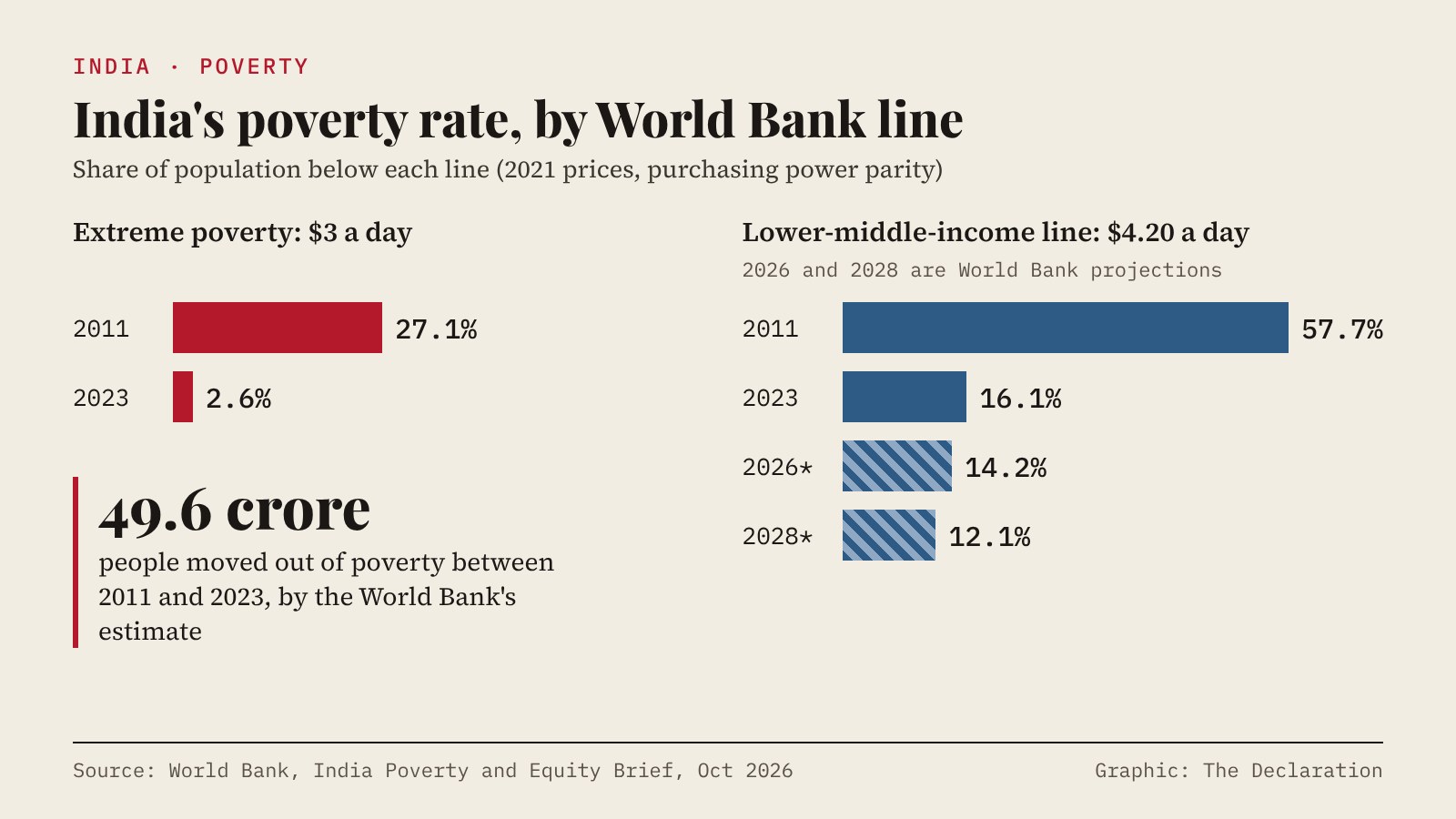
India's extreme poverty rate fell from 27.1% in 2011 to 2.6% in 2023, according to the World Bank's latest Poverty and Equity Brief for India, which describes the decline as one of the fastest in the world. The brief estimates that about 49.6 crore (496 million) people moved out of poverty over those 12 years.
The same report, released this week, warns that the gains have not reached everyone evenly. Real wages have barely moved, youth unemployment has risen, and poverty is now concentrated in a belt of states running from Uttar Pradesh to West Bengal, home to about 57% of India's remaining poor.
What happened
The World Bank measures extreme poverty as living on less than $3 a day at 2021 purchasing power parity (PPP), its international poverty line. By that yardstick, the share of Indians below the line dropped from 27.1% in 2011 to 2.6% in 2023, according to coverage of the brief by The Tribune, Scroll and Outlook.
At the higher $4.20-a-day line, which the bank uses for lower-middle-income countries such as India, the poverty rate fell from 57.7% to 16.1% over the same period. The brief projects that this rate will continue to drop, to 14.2% in 2026 and 12.1% by 2028. The bank calls these projections "indicative": they are based on microsimulation and could change as new labour-market and economic data come in.
Scroll reported that, in 2023, 19.3% of India's rural population lived below the $4.20 line, compared with 8.6% of the urban population.
The World Bank attributes the fall to strong growth in household consumption, rising employment, especially among women, and expanded social transfers, including food subsidies. According to the brief, about 13.4 crore more people were in work in 2023 than in 2017, nearly double the growth in the working-age population. The Tribune and Scroll reported that much of the gain came from rural women taking up paid work.
The caveats
The brief is less upbeat about the quality of those jobs. Outlook reported that employment growth was concentrated in relatively low-productivity activities, and several outlets said real wages were broadly unchanged or stagnant over the period.
Youth unemployment rose to 15.9% in April-June 2026, from 14.6% in the same quarter a year earlier, with the increase sharpest among young women in rural areas, according to the brief as reported by Scroll and The Tribune.
Inequality in earnings remains wide. The World Bank said median earnings of the top 10% of workers were about 13 times those of the bottom 10% in 2023, according to NewsBytes, which quoted the report. Scroll reported the same 13-fold gap.
The bank also notes that as poverty fell, the households left behind increasingly share the same traits: lower education, fewer assets, little access to steady work and more dependants per earner. It added a caution on the headline figures, saying part of the recent improvement may reflect better measurement rather than only real gains in living standards, according to The Tribune and Outlook.
Background
The World Bank's estimates for India rest on household consumption surveys. For years there was no official consumption data: the 2017-18 survey was never released, and the National Statistical Office's Household Consumption Expenditure Surveys of 2022-23 and 2023-24 were the first full surveys in over a decade. They used a revised questionnaire, which is one reason economists have debated how comparable the newer numbers are with those from 2011-12.
The bank also changed its yardsticks in 2025, moving from 2017 to 2021 PPP prices and raising its extreme poverty line from $2.15 to $3 a day. On that revised basis, its brief last year put India's extreme poverty rate at 5.3% in 2022-23, according to The Tribune. The new figure of 2.6% for 2023 is lower still.
Other measures point the same way, though less steeply. The Oxford Poverty and Human Development Initiative's multidimensional poverty index, which counts deprivations in health, education and living standards, fell from 53.8% in 2005-06 to 16.4% in 2019-21. The World Bank's own multidimensional measure stood at 15.5% in 2022-23, the brief says.
What they are saying
Finance Minister Nirmala Sitharaman, in a post on X reported by The Hans India, pointed to the drivers identified in the report and said the government's policy efforts were "yielding tangible results".
BJP national spokesperson Pradeep Bhandari wrote on X that India had lifted 49.6 crore people out of poverty under Prime Minister Narendra Modi, calling it the most any government had achieved, according to The Tribune.
No response from opposition parties had been reported by Saturday afternoon. Last year, when the World Bank published its previous estimates, the Congress questioned the government's reading of the bank's data on poverty and inequality.
What happens next
The bank's projections suggest the share of Indians below $4.20 a day will keep falling through 2028, but the brief ties that to job creation and wages. The government's next round of consumption data, and the quarterly labour surveys that now track youth unemployment, will show whether the trend in jobs and pay holds.
The concentration of poverty in the eastern and northern states is likely to sharpen attention on Uttar Pradesh, Bihar, Jharkhand and West Bengal, where the bank's figures suggest most of the remaining work lies.
Key numbers
Extreme poverty ($3 a day): 27.1% in 2011, 2.6% in 2023
Poverty at $4.20 a day: 57.7% in 2011, 16.1% in 2023; projected 14.2% in 2026 and 12.1% in 2028
People moved out of poverty, 2011-2023: about 49.6 crore
Rural vs urban poverty at $4.20 a day, 2023: 19.3% vs 8.6%
Share of India's poor in the Uttar Pradesh-West Bengal belt: about 57%
Youth unemployment, April-June 2026: 15.9%, up from 14.6%
Sources
- The Tribune: India's extreme poverty falls from 27.1% to 2.6% in 12 yrs: World Bank
- Scroll: Extreme poverty in India falls to 2.6%, but top 10% earn 13 times more than bottom 10%: World Bank
- Outlook: World Bank: India lifted 496 million people out of poverty between 2011 and 2023
- The Hans India: India records one of world's fastest poverty declines: World Bank
- NewsBytes: India's extreme poverty rate drops from 27.1% to 2.6% but...
- The Tribune: Extreme poverty in India down to 5.3% from 27.1%: World Bank (2025)
- World Bank: India Poverty and Equity Brief, October 2026 (PDF)
This story was researched and drafted with AI assistance and reviewed by an editor before publication. Spotted an error? Tell us. Corrections log.